
In the world of industrial manufacturing, measuring the flow of liquids is a daily necessity. However, traditional methods often come with a massive headache: the need to cut pipes. For any plant manager, cutting into a main line means shutting down production, risking leaks, and spending hours on labour. As a leading Ultrasonic Flow Meter Manufacturer, we understand that modern factories cannot afford these delays. The demand for smarter, faster, and cleaner measurement has never been higher.
Many facilities struggle with aging infrastructure where traditional mechanical meters have failed or clogged. Replacing these often involves heavy machinery and significant safety risks. This is where the shift toward Non-Contact Flow Measurement is changing the game. By using sound instead of physical blades or rotors, industries can now monitor their fluids without ever touching the liquid inside. This article explores how this technology works and why it is the preferred choice for engineers today.
Why Traditional Flow Measurement Creates Industrial Problems
For decades, if you wanted to know how much water or chemical was moving through a pipe, you had to install a meter inside the flow path. While this worked, it created a long list of industrial problems that still plague factories today.
- ▸Production Downtime: To install a traditional meter, you must stop the pumps, drain the pipes, and cut the metal. For a 24/7 power plant or chemical factory, one hour of downtime can cost thousands of dollars.
- ▸Leakage Risks: Every time you cut a pipe and add a flange or a joint, you create two new potential leak points. Over time, vibration and pressure can cause these joints to fail.
- ▸Pressure Loss: Mechanical meters (like turbine or paddlewheel) have parts that sit inside the liquid. These parts create “drag,” which lowers the pressure. To fix this, plants have to run their pumps harder, wasting electricity.
- ▸High Maintenance Costs: Moving parts wear out. Gritty water or corrosive chemicals can destroy internal sensors in months, leading to constant repair cycles.
The Reality Check for Engineers:
1
2
3
How Ultrasonic Flow Meter Technology Solves These Challenges
Modern engineering has moved toward “non-intrusive” solutions. An Ultrasonic Flow Meter Manufacturer focuses on solving the problems mentioned above by keeping the equipment on the outside of the pipe.
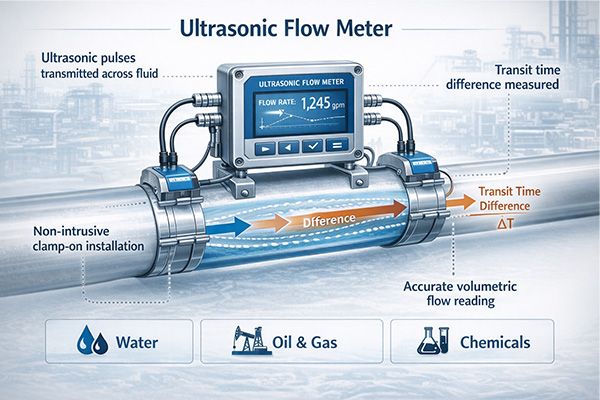
The biggest breakthrough is the Clamp on Ultrasonic Flow Meter. Instead of cutting the pipe, you simply strap two sensors onto the exterior. This approach offers a “solution-based” way of thinking:
- ▸No Pipe Damage: The integrity of your piping system remains 100% intact. There is no welding, no drilling, and no flanges required.
- ▸Live Installation: You can install these meters while the liquid is flowing at full speed. There is no need to shut down the factory or wait for a holiday break.
- ▸Zero Contamination: Because the sensors never touch the liquid, they are perfect for ultra-pure water, food products, or dangerous acids.
- ▸Infinite Life Span: Since the sensors don’t face friction or corrosion from the fluid, they last much longer than mechanical versions.
Imagine a large cooling tower line in a steel plant. Instead of a week-long project to install a meter, an engineer can now set up a monitoring station in less than an hour using a clamp-on kit.
Understanding Non-Contact Flow Measurement in Simple Language
If you have ever seen a medical ultrasound of a baby, you already understand the basics of Non-Contact Flow Measurement. The doctor moves a probe over the skin, and sound waves “see” what is happening inside without any surgery.
In industry, we use the Transit Time Principle. Here is the simple breakdown:
1
2
3
4
It is a clean, mathematical way to measure flow using nothing but high-frequency sound waves that the human ear cannot even hear.
Inside the Design Approach of an Ultrasonic Flow Meter Manufacturer
Building a reliable meter isn’t just about the sensors; it’s about the “brain” behind the sound. As a professional Ultrasonic Flow Meter Manufacturer, the design focus is split into four main parts:
1. Ultrasonic Sensors (The Ears)
Made of piezoelectric crystals that convert electricity into sound vibrations. High-quality manufacturers use “matched pairs” to ensure both sensors behave exactly the same under different temperatures.
2. The Transmitter Unit (The Brain)
The box that sends the signals. It must be powerful enough to push sound through thick metal pipes (like cast iron or stainless steel) and through the liquid inside.
3. Signal Processor
Acts like noise-cancelling headphones. It filters out the background vibration from pumps and motors so it only listens to the specific flow signal.
4. Display Interface
Modern meters feature backlit LCD screens that show flow and “signal strength,” helping a maintenance manager know if sensors are placed correctly.
Industrial Situations Where Clamp On Ultrasonic Flow Meter Becomes the Best Solution
While there are many types of meters, the Clamp on Ultrasonic Flow Meter is the “Swiss Army Knife” of the industrial world. Here are five scenarios where it is clearly the best choice:
- ▸Existing Pipeline Monitoring: If you have an old factory and don’t know the exact flow rates, you can’t just cut the pipes. The clamp-on meter allows you to add monitoring to 20-year-old lines instantly.
- ▸Temporary Measurement: Sometimes you only need to check a pump’s performance for one day. You can strap the meter on, take your readings, and take it to the next machine.
- ▸Energy Audits: If you are trying to save water or chemicals, you need data. Portable ultrasonic meters are the primary tool for energy auditors worldwide.
- ▸Corrosive or Toxic Fluids: Measuring sulfuric acid or wastewater is dangerous. By using non-contact sensors, you keep your workers safe from exposure to harmful chemicals.
- ▸Large Diameter Pipes: Buying a 1000mm magnetic flow meter is incredibly expensive and heavy. A clamp-on ultrasonic meter costs nearly the same for a small pipe as it does for a massive one.
Industries Benefiting from Ultrasonic Flow Meter Supplier Solutions
Every major industry is moving toward these systems. As an Ultrasonic Flow Meter Supplier, we see the following common applications:
| Industry | Problem | Ultrasonic Solution |
|---|---|---|
| Water Treatment | Sand and grit destroy mechanical meter blades. | Non-contact sensors are outside, so sand cannot hurt them. |
| HVAC Systems | Large chilled water lines are hard to shut down for repair. | Clamp-on meters install while the building is cooling. |
| Chemical Plants | Corrosive acids eat through internal sensors. | Sensors stay on the outside of the pipe wall, safe from acid. |
| Power Plants | High-pressure steam and water lines are dangerous to cut. | Ultrasonic tech measures through the pipe without a breach. |
| Food Industry | Internal meters can trap bacteria and cause rot. | The pipe stays smooth and hygienic inside; no traps. |
Advantages of Choosing an Ultrasonic Flow Meter Manufacturer in Ahmedabad
Ahmedabad has emerged as a global hub for industrial automation and instrumentation. Choosing an Ultrasonic Flow Meter Manufacturer in Ahmedabad provides several strategic advantages for local and international buyers:
- ▸Local Technical Support: You don’t have to wait for an engineer to fly in from another country. Local experts can visit your site for a “dry run” or signal check.
- ▸Fast Installation & Service: Being close to the manufacturing base means spare parts and sensors are available within 24–48 hours.
- ▸Customized Solutions: Local manufacturers understand the specific challenges of Indian industries — such as power fluctuations or dusty environments — and build meters to withstand them.
- ▸Direct Factory Pricing: By cutting out the middlemen, you get high-end technology at a price that fits your maintenance budget.
Installation Problems Engineers Face and How Ultrasonic Technology Prevents Them
In the field, things rarely go perfectly. Engineers often face “nightmare” scenarios during installation. Here is how ultrasonic technology acts as a troubleshooting tool:
Scenario 1: The “No-Stop” Mandate
The boss says, “We can’t stop the line for even ten minutes.”
Solution: Since it’s a Clamp on Ultrasonic Flow Meter, you don’t need a shutdown. You clean the pipe surface, apply coupling gel, and strap on the sensors.
Scenario 2: Pressure Drops
A mechanical meter is causing a pressure drop, making the final process slow.
Solution: Because there is nothing inside the pipe, there is zero pressure loss. Your pumps can run at a lower, more efficient speed.
Scenario 3: Old, Scaled Pipes
Over years, pipes get a layer of “scale” or rust inside.
Solution: Modern ultrasonic meters have “gain control.” They can turn up the “volume” of the sound wave to punch through scale and get an accurate reading where other meters would fail.
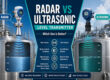
Comparing Ultrasonic Flow Meter with Other Flow Measurement Technologies
How does this technology stack up against the “old guard”?
Vs. Electromagnetic Meters (Mag Meters)
Mag meters are great, but they only work with conductive liquids (like water). They won’t work with oils or distilled water. An ultrasonic meter works with almost any liquid that can carry sound. Plus, Mag meters require you to cut the pipe.
Vs. Turbine Meters
Turbine meters have a spinning wheel. If a piece of debris hits that wheel, the meter is dead. Ultrasonic meters have no moving parts. They don’t care if there is a bit of debris in the water.
Vs. Mechanical Meters
Mechanical meters wear out and lose accuracy over time. Ultrasonic meters stay accurate because their “measurement tool” (sound) doesn’t wear out.
How Non-Contact Flow Measurement Improves Plant Efficiency
Efficiency isn’t just about using less power; it’s about better management. Non-Contact Flow Measurement helps a business grow in several ways:
- ▸Reduced Downtime: You never have to stop production to fix or calibrate the meter.
- ▸Lower Maintenance: No moving parts means your maintenance team can focus on other machines.
- ▸Accurate Monitoring: Knowing exactly how much water you use allows you to spot leaks early, saving thousands in utility bills.
- ▸Energy Savings: With zero pressure drop, your electricity bill for pumps will naturally decrease.
- ▸Data Integrity: Modern meters can connect to your computer (SCADA) system, giving you real-time graphs of your factory’s health.
Future of Ultrasonic Flow Measurement in Smart Industries
We are entering the era of Industry 4.0. This means factories are getting “smarter.” Future ultrasonic meters will not just show a number on a screen; they will send an alert to your smartphone if they detect a leak.
- ▸Remote Diagnostics: A technician from an Ultrasonic Flow Meter Manufacturer could log into your meter from miles away to help you calibrate it.
- ▸Wireless Sensors: Imagine a meter that doesn’t even need a wire to send data to the control room.
- ▸Digital Twins: Flow data will be used to create computer models of entire cities’ water systems, predicting pipe bursts before they happen.
FAQ Section
1. What is an Ultrasonic Flow Meter?
It is a device that measures the speed of a liquid in a pipe by using sound waves. It doesn’t require cutting the pipe because it “listens” to the flow from the outside.
2. Can I use a Clamp on Ultrasonic Flow Meter on any pipe material?
Yes, most meters work on metal (Steel, Iron, Copper) and plastic (PVC, PE) pipes. As long as the pipe is solid and not full of air bubbles, the sound can pass through.
3. Does a Non-Contact Flow Measurement system require frequent calibration?
Because there are no moving parts to wear out, these meters stay calibrated much longer than mechanical ones. Most industrial users check them once a year.
4. Why should I choose an Ultrasonic Flow Meter Manufacturer in Ahmedabad?
Choosing a local manufacturer ensures you get rapid technical support, customized sensor mounting for your specific pipe types, and faster delivery of spare parts.
5. Will the meter work if the liquid has some bubbles?
Small amounts of bubbles or solids are okay. However, if the pipe is half-empty or has too many bubbles, the sound wave might get blocked. Always ensure the pipe is full.
6. Is it hard to install the sensors?
Not at all. You just clean the pipe, apply a little grease (coupling gel), and use the provided clamps. Most engineers can do it in 15–20 minutes.
7. What is the difference between Transit-time and Doppler ultrasonic meters?
Transit-time (most common) is for clean liquids. Doppler is for “dirty” liquids like raw sewage that have lots of particles for the sound to bounce off of.
8. Can an Ultrasonic Flow Meter Supplier provide portable versions?
Yes. Portable kits come in a suitcase with batteries, allowing you to move around the factory and check flow rates at different locations.
9. Does pipe wall thickness matter?
Yes. When setting up the meter, you must enter the pipe thickness into the computer so it can calculate the “path” of the sound wave accurately.
10. Can it measure flow in both directions?
Yes, most ultrasonic meters are bi-directional. They can tell you if the liquid is flowing forward or backward.
Conclusion
Choosing the right flow measurement technology is a decision that impacts your factory’s bottom line for years. By moving away from outdated, invasive methods and embracing the solutions provided by a professional Ultrasonic Flow Meter Manufacturer, you eliminate the risks of downtime, leaks, and high maintenance costs. Whether you are looking for a permanent Clamp on Ultrasonic Flow Meter for a cooling system or a portable unit for energy audits, the benefits of Non Contact Flow Measurement are clear. It is safer, faster, and more efficient for the modern engineer.