
Which Conductivity TDS Meter Fits Your RO or DM Plant
Choosing a conductivity TDS meter for RO and DM plants starts with the water at each measuring point. Select a sensor and range that can show the changes your process needs to detect. A meter used on feedwater may need a different setup from one used on the outlet of a demineralisation plant.
Two displays can show different numbers for the same sample. Sometimes the cause is a TDS conversion setting. In other cases, temperature, a trapped bubble or exposure to air changes the result. Replacing the instrument may leave the real problem untouched.
This buying guide explains what to check before choosing a meter, probe or controller. It covers useful measuring points, small changes in water quality and the questions that make supplier quotations easier to assess. Take these checks to suppliers.
Know What Conductivity and TDS Actually Tell You
Conductivity shows how easily water carries an electric current. Dissolved ions, such as those from salts, help carry that current. Conductivity is commonly shown in microsiemens per centimetre, written as µS/cm, or millisiemens per centimetre, written as mS/cm.
TDS means total dissolved solids. Most electronic TDS meters estimate this value from conductivity using a conversion factor. They do not weigh or identify every dissolved substance. TDS is often displayed in ppm, meaning parts per million.
For routine plant checks, this estimate can be useful when the settings are known. For very pure water, a direct conductivity reading often gives a clearer basis for tracking small changes.
Neither reading provides a complete picture of water quality. Other tests may be needed for concerns such as silica, organic contamination or microbes, depending on the intended use.
Map the Measuring Points in Your RO and DM Plant
RO means reverse osmosis. It uses membranes to separate water from much of its dissolved salt content. DM means demineralisation, commonly involving ion exchange to remove dissolved ions.
The meter should match the point being measured. List the normal value, likely variation and action limit for each location before requesting a model.
| Measuring Point | What the Reading Helps You Track | Buying Focus |
|---|---|---|
| RO feedwater | Changes in incoming ionic content | Range covering normal feed and expected variation |
| RO permeate outlet | Quality of water passing through the membrane | Reliable measurement at the lower product water range |
| DM outlet | Small increases in ionic contamination | Suitable sensor, low range accuracy and temperature treatment |
| Storage or distribution return | Changes after treatment and during circulation | Sample location, clean installation and comparison settings |
Set the required limits from your process needs. Boiler makeup water, general washing water and a demanding production process do not automatically need the same specification.
Select a Conductivity Meter Range That Shows Small Changes
A large advertised range can look attractive, but it says little about performance near your action limit. Check the complete accuracy statement and the sensor’s approved range.
Consider an illustrative meter specified as accurate to 1 percent of a fixed full scale of 2000 µS/cm. That percentage equals 20 µS/cm. Such a specification alone would not support a decision based on a change around 1 µS/cm. This is a calculation example, not an Aranka product specification.
An instrument with several selectable ranges may behave differently, so ask how accuracy applies on the range you will use. Also check any fixed error added to the percentage figure.
Resolution is the smallest displayed step. More decimal places do not prove better accuracy. Ask the supplier to state expected performance around your normal reading and alarm point, rather than only at the top of the range.
Match the Conductivity Sensor and Cell Constant
The cell constant describes how the measuring cell’s geometry relates electrical conductance to conductivity. It is often marked as K. The controller must use the correct value for the connected sensor.
Lower cell constants, such as 0.01 or 0.1 per centimetre, are commonly considered for low conductivity water. The useful range still depends on the actual sensor and electronics. Choose the pair together instead of selecting a K value by itself.
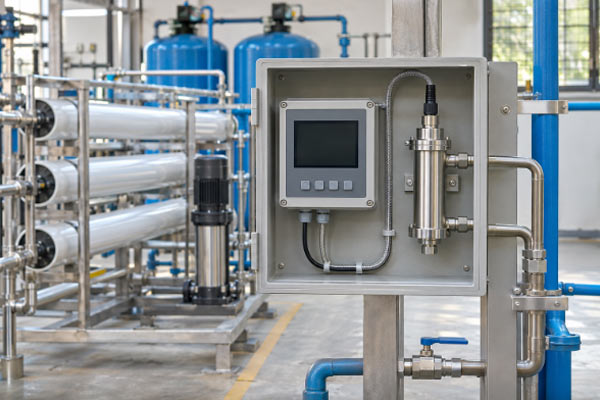
Two electrode cells are often used for pure water measurement. Other designs can cover different or wider ranges. Tell the supplier whether the point is feedwater, RO permeate or DM water so the sensing method can be reviewed.
Check the temperature element too. Its type must be supported by the controller. An existing probe is not automatically compatible with a replacement display, even when the cable colours or connector appear similar.
Set the TDS Conversion Factor Before Comparing Meters
A conductivity TDS meter can show different ppm values when a different conversion factor is selected. This does not necessarily mean either conductivity measurement is wrong.
The simplified calculation is TDS in ppm equals conductivity in µS/cm multiplied by the selected factor, using the meter’s stated temperature basis.
| Conductivity Used for Conversion | Selected Factor | Calculated TDS |
|---|---|---|
| 100 µS/cm | 0.50 | 50 ppm |
| 100 µS/cm | 0.70 | 70 ppm |
These are illustrative settings, not a recommendation for every water sample. The suitable relationship depends on the dissolved substances and the method your plant uses.
Before comparing two TDS readings, record both factors and temperature settings. Do not change a factor merely to make the displays agree. Confirm why the selected conversion is appropriate for the water being tested.
Check Temperature Compensation for RO and DM Water
Conductivity changes with temperature. Many meters calculate a reading at a chosen reference temperature, often 25 degrees Celsius, so results can be compared more consistently.
Automatic temperature compensation uses a temperature measurement and a correction method. It does not make temperature irrelevant. The method must suit the water.
A fixed linear correction can work for suitable solutions, while very pure water needs closer attention because its temperature response is not simply linear. Ask whether the proposed controller supports the required compensation method at your DM outlet.
When investigating a difference between instruments, compare the measured temperature, reference temperature and correction mode. If one device shows conductivity at the sample temperature and another shows a corrected value, the numbers may differ for a valid reason.
Choose Online Conductivity Monitoring or Portable Checking
An online conductivity meter provides a continuous reading while the process runs. With suitable outputs and control logic, it can feed a trend display, trigger an alarm or support a water diversion arrangement.
A portable instrument is useful for spot checks and investigations. It gives a result for the sample at the time of testing. It cannot, by itself, show every change between checks.
For important process points, the two approaches can support each other. The comparison method needs care, especially with DM water that changes after sampling.
Decide whether you need only a display or also a controller. Confirm power supply, relay functions and outputs such as 4 to 20 mA or Modbus. Have the plant team define alarm limits, delays and the required response to an instrument fault.
Keep the Conductivity Sample Clean and Free of Bubbles
Very low conductivity water can absorb carbon dioxide from air. This changes its conductivity. A sample left in an open cup may therefore read differently from water measured in a closed process line.
A suitable closed flow cell can reduce this sampling effect. Its tubing and surfaces must also be clean. Residue from a previous sample or cleaning solution can matter when the water contains very few ions.
Bubbles touching the measuring surfaces can disturb the reading. Ask for installation guidance that keeps the cell properly filled and allows air to clear. Follow the specified flow, pressure and mounting conditions.
Avoid long sample routes that make the result slow to reflect a process change. The instrument may respond quickly while old water is still travelling through the sample tube.
Buy a Conductivity TDS Meter You Can Verify
Calibration, verification and cleaning should be practical for your maintenance team. Ask what each task requires before placing the order.
A certified conductivity standard has a stated value under defined conditions. Use the manufacturer’s recommended method and a suitable standard. Very low conductivity standards are especially sensitive to contamination and handling.
Some pure water sensors use a factory determined cell constant and specific verification methods. Do not assume that every instrument needs the same field calibration routine. A fresh standard, a clean cell and a checked temperature reading all matter.
Read RO and DM Trends Before Blaming the Sensor
A rise in RO permeate conductivity deserves investigation, but it does not identify the cause on its own. Feedwater quality, operating conditions, sampling and membrane condition may all need review.
Compare readings on the same temperature basis and check the feedwater trend. A product reading without its operating context can lead to an early membrane replacement or a missed process problem.
At a DM outlet, a rising reading may indicate reduced ion removal, unwanted mixing or contamination. First confirm that the measuring cell is clean, the temperature value is sensible and the setup has not changed.
Keep a record of the action taken and the result. That history is useful when deciding whether the next purchase needs a different sensor, better sampling or additional monitoring points.
Compare Conductivity TDS Meter Price and Supplier Offers
Conductivity TDS meter price depends on the whole package. A display alone is not directly comparable with a controller supplied with a probe, flow cell, cable and commissioning support.
| Quotation Item | Detail to Request | Why It Matters |
|---|---|---|
| Measurement performance | Range and accuracy at the intended water quality | Confirms whether small process changes can be assessed |
| Sensor package | Model, cell constant, temperature element and materials | Establishes compatibility with the controller and water |
| Installation parts | Connection, flow cell, cable and mounting accessories | Makes the required installation work clear |
| Settings and outputs | Temperature method, TDS factor and control signals | Helps prevent mismatched readings or panel connections |
| Service and documents | Verification method, records, warranty and support scope | Clarifies ongoing maintenance and purchase terms |
Ask for an itemised offer and identify exclusions. Include freight, taxes and setup assistance where relevant. When a lower priced offer uses a different sensor or accuracy basis, compare those differences before deciding.
Questions for a Conductivity TDS Meter Manufacturer
A conductivity TDS meter manufacturer should explain why the proposed system suits your particular measuring point. Ask for a clear answer about the lowest useful range, temperature correction and sensor choice.
If you are comparing a conductivity TDS meter supplier in India, send recent readings with their units and settings. A photograph showing only “12” leaves too much uncertainty. State whether it means ppm, µS/cm or another value.
Aranka Instruments LLP lists ACS conductivity sensors with several cell constant options and ACT2596 conductivity controllers. Discuss the exact configuration needed for your RO or DM point, including whether its performance meets your low conductivity requirement.
For plants in Ahmedabad and Gujarat, also clarify installation assistance and how technical queries will be handled after supply.
Conclusion Specify the Water Before Selecting the Meter
A useful conductivity TDS meter makes changes in your water quality clear enough to act on. That requires a suitable range, matched sensor, correct settings and a sample that represents the process.
To discuss an RO or DM application, send your requirements to Aranka Instruments LLP. Include the measuring location, expected values, action limit and installation details so the proposed package can be assessed properly.
Frequently Asked Questions
Select for the expected DM outlet conductivity and the change you need to detect. Review the sensor cell constant, accuracy at low values and temperature method. A meter that covers feedwater may need a different sensor or configuration for this point.
Check their conversion factors and temperature settings first. The same conductivity can produce different calculated TDS values. If those settings agree, review calibration, sample handling and sensor condition. Comparing direct conductivity readings can help separate conversion differences from measurement differences.
No. The reading may reflect the display resolution and selected conversion factor. It does not prove that all impurities are absent. Use a meter with suitable low conductivity performance and the other tests required for the intended water use.
Some systems cover a wide range, but suitability must be confirmed for both points. Ask for the sensor and controller’s performance near each expected value. Do not assume that a broad display range guarantees equal accuracy throughout it.
Air exposure, carbon dioxide absorption, container residue and temperature differences can change the result. Check whether both instruments use comparable settings. For very low conductivity water, ask about a suitable closed flow cell and a controlled comparison method.
Request the controller, matched sensor, cell constant, temperature element, cable and required flow cell. Add performance details, outputs, calibration or verification documents and support terms. Clearly identify optional items so you can compare the complete package.
It can support diversion when its outputs are connected to a suitable control arrangement. Confirm relay or signal compatibility and have the plant team define limits, delays and fault behaviour. Buying a controller alone does not establish the complete diversion system.