
What Should You Check Before Choosing a Vortex Flow Meter for Steam
A common mistake when buying plant instrumentation is ordering a flow meter based on pipe size alone. A buyer orders a 100 mm meter for a 100 mm pipe, installs it, and soon finds it cannot read the actual flow. Why? Because the normal flow rate, steam temperature, and line pressure were never checked. When choosing a Vortex Flow Meter for Steam, matching the pipe diameter is not enough. You must understand the exact steam conditions inside that pipe.
This guide will help you collect the right system data before you place an order. It shows you how to check if a vortex meter suits your application, how to avoid common sizing mistakes, and what questions you need to answer before asking a supplier for a quote. Getting these details right ensures accurate billing, better boiler control, and a safer working environment.
The Direct Answer to Steam Flow Meter Selection
To choose the right instrument, you need accurate operating details. Pipe diameter simply tells you the size of the hole the steam flows through; it does not tell you how fast or how hot the steam is moving. A buyer must collect the minimum, normal, and maximum flow rates, the operating pressure, and the maximum temperature. Without these facts, you cannot perform proper vortex flow meter sizing. Always size the meter for the actual fluid velocity, not just the physical pipe connection.
Is a Vortex Meter Suitable for Your Steam Line?
A steam vortex flow meter works using the von Kármán principle. As steam flows past an obstruction (a bluff body) inside the meter, it creates alternating swirls, or vortices. The meter counts these vortices to determine the flow velocity. Before buying, check if your system supports this working principle.
- Flow Range: Vortex meters need a minimum flow speed to generate readable vortices. If your steam moves too slowly, the meter will read zero.
- Steam Condition: These meters handle saturated and superheated steam well. However, very wet steam with heavy water droplets can damage the sensor and cause reading errors.
- Pipe Layout: The meter requires a uniform flow profile. If you have to install the meter directly next to a pressure-reducing valve, the disturbed flow will ruin the accuracy.
- Vibration: Modern meters include anti-vibration features, but severe pipe shaking from heavy pumps can still cause false readings.
If your steam line has very low flow, constant pressure drops, or heavy mechanical vibration, you should ask an instrumentation engineer to review the application before buying.
Steam Data to Collect Before Sizing
Do not guess your system parameters. Use this table to gather the exact information needed for an accurate vortex flow meter for steam lines.
| Information Needed | Why It Matters | Where the Buyer Can Find It |
| Steam type (saturated, superheated, or wet) | Determines how the meter will calculate density and final mass flow. | Boiler manual, process design data, or the plant engineer. |
| Minimum and maximum flow | Ensures the flow speed stays within the meter’s measurable range (Reynolds number). | Historical DCS data or calculated plant steam demand. |
| Normal flow | The meter must be most accurate at the flow rate your plant uses daily. | Shift operator logs or boiler output records. |
| Operating pressure | Required to safely rate the meter body and calculate saturated steam density. | Pressure gauges on the current steam line. |
| Maximum temperature | Ensures the sensor electronics will not overheat and fail. | Temperature transmitters near the installation point. |
| Pipe size and schedule | Helps the supplier match the meter flanges to your existing pipe network. | Piping and instrumentation diagrams (P&ID) or pipe markings. |
| Required output | Ensures the meter can communicate with your specific control room system. | Electrical or automation department guidelines. |
Pipe Layout and Installation Checks
Available Straight Pipe: Vortex meters require a straight, unobstructed run of pipe before and after the meter to ensure the steam flows smoothly. Never assume a standard distance fits all meters. Always check the chosen model’s manual for exact straight-run requirements.
Nearby Elbows or Valves: Valves, elbows, and reducers create turbulence. Install the flow meter upstream of control valves whenever possible to avoid measuring distorted steam.
Vibration and Support: If the pipe shakes visibly, you must install proper pipe supports on both sides of the meter to prevent false vortex readings.
Condensate Management: Steam lines naturally form liquid condensate. Install proper steam traps upstream to remove liquid water. Heavy water hammer will damage the sensor bluff body.
Meter Orientation: Avoid installing the electronics enclosure directly underneath a steam pipe where leaking condensate could drip onto the display.
Safe Access: Ensure the location allows technicians safe access for wiring, viewing the LCD display, and future maintenance.
Volumetric Flow vs Mass Flow in Steam Systems
When dealing with steam, buyers must choose between volumetric flow and mass flow.
Volumetric flow measures the physical space the steam takes up inside the pipe. However, steam changes density when pressure or temperature fluctuates. If the boiler pressure drops, the steam expands. A volumetric meter will show the same volume, even though you are receiving less actual heat energy.
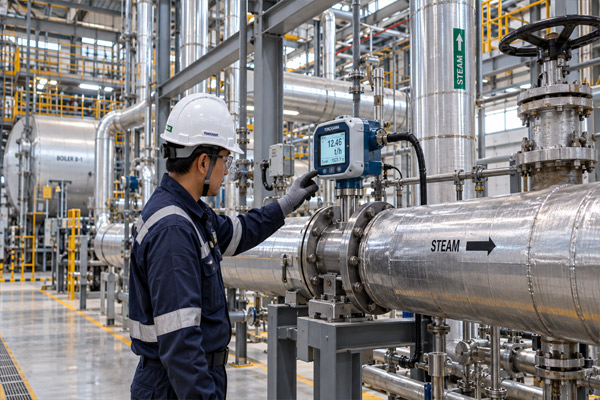
Mass flow measures the actual weight of the steam (usually in kilograms or tons per hour). This is essential for steam mass flow measurement, energy tracking, and customer billing. To get mass flow, the meter must know the steam’s pressure and temperature to compensate for density changes. Aranka Instruments’ vortex flow meters feature an in-built RTD (temperature sensor) and pressure sensor. This allows the instrument to calculate density and display accurate mass flow directly on the screen without needing separate external transmitters.
Illustrative Selection Example: Collecting the Right Data
Consider an illustrative plant that needs a new flow meter for a critical boiler outlet. The procurement team initially plans to order a 150 mm meter simply because the pipe is 150 mm wide.
Before ordering, the plant engineer stops the purchase and asks a few key questions: What is our lowest flow during the night shift? Is this steam superheated or saturated? What is the maximum temperature the meter will face?
They check the boiler logs and find out the night shift flow drops significantly, and the steam reaches temperatures up to 240°C. Armed with the minimum flow, maximum temperature, and operating pressure, they approach a vortex flow meter supplier in Ahmedabad. Because they provided actual operating data, the supplier recommends reducing the meter size to ensure it accurately captures the low night-shift flow, while selecting a high-temperature (T2 Level) sensor to handle the heat.
Specification Checklist for a Supplier Enquiry
When you are ready to request a quotation from a vortex flow meter manufacturer, copy this checklist and fill in your details. Providing complete information guarantees a faster and more accurate quote.
- Application: (e.g., Boiler outlet, heating jacket, billing line)
- Steam Condition: (Saturated steam, superheated steam, or wet steam)
- Flow Range: (Minimum, Normal, and Maximum in kg/hr or ton/hr)
- Operating and Design Limits: (Normal operating pressure and maximum temperature, e.g., up to 350°C)
- Pipe and Flange Details: (Line size between 25 to 200 mm, and preferred connection like ANSI, DIN, or WAF)
- Installation Space: (Available straight pipe run in meters)
- Power Supply: (Typically 24VDC)
- Display Preferences: (Local LCD display, direct mount, or remote mount electronics)
- Outputs Required: (4-20 mA 2-Wire, Modbus RS485, or Ethernet)
- Calibration: (Request factory calibration documentation)
Common Buying Mistakes and Their Solutions
Avoid these common traps when acting as a buyer or procurement agent for steam instrumentation.
| Problem | Possible Effect | Check Before Ordering |
| Choosing by pipe size alone | The meter may not read low weekend flow rates, causing lost billing data. | Calculate the exact minimum and maximum flow velocity to correctly size the meter. |
| Assuming all steam is dry | Water droplets hit the sensor, causing reading spikes and permanent mechanical damage. | Ensure adequate steam traps and insulation are in place before installing the meter. |
| Using volumetric flow for billing | Density changes lead to inaccurate energy billing and poor boiler efficiency tracking. | Select a meter with built-in temperature and pressure compensation for direct mass flow. |
| Overlooking the signal type | The installed meter cannot connect to the plant’s control room. | Confirm whether the plant’s PLC requires a 4–20 mA, Modbus RS485, or Ethernet connection. |
Conclusion
Selecting the right vortex flow meter for steam lines requires more than just matching a pipe diameter. By collecting your exact flow range, pressure, and temperature data, you protect your plant from inaccurate readings and poor energy management. Remember to account for straight pipe runs, manage condensate properly, and choose an instrument capable of true mass flow measurement.
Once you have gathered your steam data using the checklists above, you are ready to speak with a manufacturer. Review Aranka Instruments’ Vortex Flow Meters to find models with built-in compensation, durable stainless steel construction, and the right outputs for your plant.
FAQs
To size a meter correctly, a buyer must provide the minimum, normal, and maximum flow rates. You also need the operating pressure, maximum temperature, pipe size, and the type of steam (saturated or superheated). This ensures the steam velocity falls within the meter’s readable range.
Yes, vortex meters are highly effective for saturated steam. Because the temperature and pressure of saturated steam are directly linked, the meter can calculate the steam’s density using just one built-in pressure or temperature sensor, providing accurate mass flow readings.
For a superheated steam flow meter, temperature and pressure act independently. The meter must have both temperature and pressure compensation to calculate accurate mass flow. You must also check that the maximum steam temperature does not exceed the sensor’s limit, which can be up to 350°C.
A vortex flow meter relies on the steam moving fast enough to create detectable swirls (vortices) around the internal bluff body. If the steam flows too slowly, no vortices are formed, and the meter will register zero flow, leading to lost data.
Yes, severe pipeline vibration can mimic the frequency of vortices, causing the meter to register false flow rates. While quality meters include advanced signal processing for better anti-vibration, heavy shaking requires proper pipe supports or a different measurement technology.
Buyers should request outputs that match their plant’s control systems. Standard industrial options include a 4-20 mA analog output for basic flow signaling, or digital communication like Modbus RS485 and Ethernet for transmitting mass flow, temperature, and pressure data simultaneously.
Send the manufacturer your exact minimum and maximum flow rates, operating pressure, maximum temperature, pipe diameter, and flange type. You should also specify whether the steam is saturated or superheated, and list your required power supply and control room communication outputs.