

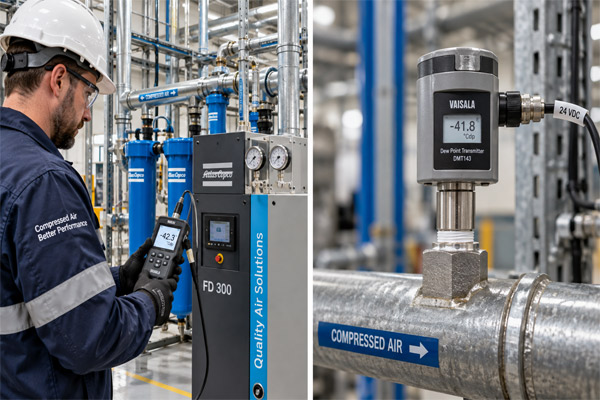
When Do You Need a Handheld or Online Dew Point Meter
Imagine a team walking the plant floor, taking occasional spot readings on compressed air lines. The air seems dry during the check, but what happens overnight? Moisture may rise between checks, causing unseen damage to tools or products. Choosing between a handheld vs online dew point meter comes down to a simple question: what happens if your dry air quality drops while nobody is watching?
The right choice depends on your monitoring frequency, required response time, and the sensitivity of your process. A portable dew point meter works well for periodic checks and troubleshooting across multiple zones. On the other hand, an online dew point meter offers continuous tracking, catching moisture spikes the second they happen. This guide will help you decide when a portable reading is enough and when continuous monitoring is worth buying.
Quick Answer: The Decision Rule for Dew Point Monitoring
When choosing a compressed air dew point meter, the best approach depends on how your plant operates. Here is a direct decision rule to follow:
- Choose a handheld meter if your team needs to test multiple air lines across different zones. It is ideal for periodic checks and troubleshooting where minor moisture fluctuations will not instantly ruin products.
- Choose an online meter if your process demands strict moisture control. When a sudden drop in dry air quality causes costly downtime, continuous dew point monitoring is required to trigger immediate alerts.
- Choose both if you manage a large facility. A fixed online unit protects your most sensitive equipment 24/7, while a portable dew point meter allows maintenance teams to investigate the rest of the plant.
How Each Type Works in Daily Use
Before purchasing an instrument, it helps to know how your team will actually use it on the floor.
Handheld models require manual action. A maintenance technician or air dryer operator carries the device to a specific test point. They connect the sampling hose, turn on the meter, and wait a few minutes for the sensor to stabilize. The operator reads the value directly on the screen and logs it into a maintenance record. Once the test is done, the meter goes back into its case.
Online models operate without manual intervention. A technician permanently installs the transmitter directly into the pipe or air dryer outlet. Using a standard 24 VDC power supply, the sensor constantly measures the moisture in the air stream. It sends real-time data back to a central control system. If the moisture crosses a dangerous threshold, the system immediately records the event and triggers alarms.
Handheld vs Online Comparison Table
A clear breakdown helps buyers see the tradeoffs. Both types are valuable, but they serve entirely different daily routines.
| Feature | Handheld Dew Point Meter | Online Dew Point Meter |
| Measurement Purpose | Periodic spot checks and field audits. | 24/7 process protection and trend tracking. |
| Number of Test Points | Unlimited. Can be moved anywhere. | Fixed to one specific location. |
| Monitoring Frequency | Occasional (daily, weekly, or monthly). | Continuous (every second of the day). |
| Alarms | No automated plant alarms. | Yes, triggers external relays or SCADA alerts. |
| Data Records | Manual logging or internal device memory. | Continuous digital logging via control systems. |
| Installation Effort | Minimal. Uses quick-connect fittings. | Requires hardwiring, piping, and power supply. |
| Portability | High. Battery-powered and lightweight. | None. Permanently installed in a fixed spot. |
| Maintenance | Recharging batteries and protecting the probe. | Checking wire connections and sampling filters. |
| Typical Buyer Fit | Service teams, auditors, and general maintenance teams. | Process engineers and critical facility managers. |
Three Short Decision Examples
Example 1: A Small Workshop
- Scenario: A local metal fabrication shop uses compressed air mainly for pneumatic hand tools and basic spray painting.
- Reasoned Choice: A minor moisture spike might cause temporary spitting in a paint gun, but it will not cause catastrophic losses. A weekly spot check with a portable meter is enough to ensure the basic refrigerant dryer is doing its job.
Example 2: A Factory with a Critical Dry Air Process
- Scenario: A specialized plastics facility uses a desiccant dryer to supply ultra-dry air for medical-grade molding.
- Reasoned Choice: The process requires a strict dew point target. If moisture enters the system, the plastic parts will suffer structural defects, leading to expensive scrapped batches. A continuous transmitter with an RS-485 Modbus connection is required to alert operators immediately.
Example 3: A Maintenance Team Checking Several Sites
- Scenario: A team of service engineers travels to different regional manufacturing plants to maintain compressed air systems.
- Reasoned Choice: The engineers cannot permanently install their own sensors at client sites. They need a rugged, battery-powered tool they can carry in a case to diagnose and verify dryer performance during their service visits.
When a Handheld Meter is the Sensible Choice
A portable device is the most sensible choice for mobile troubleshooting and broad facility audits.
A handheld dew point meter allows a single operator to check several air lines across a massive plant. Instead of buying ten fixed sensors for ten different branches, you buy one portable unit. This is highly cost-effective for general pneumatic tools that do not require perfect, ultra-dry air.
It is also the best tool for spot testing after dryer service. When a technician repairs an air dryer, they can use the portable unit to verify that the equipment is working correctly before leaving the site. Field service contractors rely on these tools daily because they travel from factory to factory.
However, you must understand its limits between visits. A single spot reading only tells you that the air is dry at that exact moment. It does not prove the air stays dry all day. If the dryer fails overnight, you will not know until the next scheduled check.
When an Online Meter is the Sensible Choice
A fixed instrument is the sensible choice when you need total visibility and automated control over your air quality.
Continuous dew point monitoring protects sensitive processes like pharmaceutical packaging, additive manufacturing, and high-tech electronics. In these fields, the correct dew point target is critical. If moisture spikes, it can ruin a whole batch of product. An online unit prevents condensation, corrosion, and freezing by providing a steady stream of data.
When integrated with a smart controller, these sensors provide immediate alarms. For example, Aranka’s online transmitters offer 4–20 mA analog outputs and RS-485 Modbus RTU communication. This allows the sensor to talk directly to your plant’s PLC. If the air gets too wet, the system can automatically shut off a valve or alert the control room before damage occurs.
Keep in mind that installing an online dew point meter requires upfront effort. It needs a 24 VDC power supply, proper sensor connections (like a ¾” BSP fitting), and secure wiring. Also, remember that a sensor only reports the data; an online transmitter will not fix a faulty dryer on its own.
When Using Both Makes Sense
For many industrial plants, the best strategy is a hybrid approach.
A fixed dew point transmitter for compressed air should be installed directly after the main air dryer or right before the most critical machinery. This provides an unblinking eye on your most expensive assets.
Meanwhile, the maintenance team keeps a handheld dew point meter in the tool room. If the online sensor triggers an alarm, the team uses the portable unit to walk down the air line. They can test different branches to find exactly where the moisture is entering the system. This combined approach offers both continuous security and flexible troubleshooting.
Practical Troubleshooting: Problem and Monitoring Approach
Sometimes, the problems you experience dictate the type of tool you need. Use this compact checklist to match your issue with the right monitoring approach.
| Problem on the Floor | What to Check | Suitable Monitoring Approach |
| Water droplets found at end-use pneumatic tools. | Trace the air line back to find the exact point of moisture entry. | Handheld: Best for moving from point to point along a pipe network. |
| Unexplained dryer failure during the night shift. | Moisture load trends and dryer performance over a 24-hour cycle. | Online: Best for data logging and tracking overnight fluctuations. |
| Sudden rejection of moisture-sensitive materials. | The exact dew point condition entering the production machine. | Online: Best for immediate alarms and process shutdown relays. |
| Need to verify repairs after a dryer breakdown. | Instant air quality at the dryer outlet before restarting production. | Handheld: Best for quick, on-the-spot validation by the repair technician. |
Conclusion
Choosing between a handheld and an online instrument comes down to your plant’s tolerance for risk. A portable unit provides flexibility and cost savings for broad, multi-point checks. A fixed online transmitter delivers the constant vigilance needed to protect critical processes and prevent expensive downtime.
Assess your monitoring frequency, review your process sensitivity, and check your integration needs. Whether you need a smart controller, a blind transmitter, or a rugged portable device, selecting the right tool ensures your compressed air system stays safe and efficient.
If you are ready to upgrade your air quality monitoring, view Aranka Instruments’ range of precision Dew Point Meters or contact our team to discuss your specific application.
FAQs
A handheld meter is the better choice for checking multiple air lines. Because it is battery-powered and highly portable, a single technician can carry it across the entire facility. This allows you to spot-check different branches, trace moisture issues back to the source, and audit various zones without installing multiple fixed sensors.
No, a handheld meter cannot replace continuous monitoring. A portable unit only provides a spot reading of the air quality at the exact moment of the test. It does not track moisture levels over time. If a dryer fails between manual checks, you will not know until the next scheduled test.
Yes, online meters are designed specifically for plant integration. Models like Aranka’s online transmitters output standard 4–20 mA signals and support RS-485 Modbus RTU communication. When connected to a central PLC, SCADA system, or a dedicated smart controller, they can trigger immediate alarms if moisture levels become dangerously high.
A buyer must check the maximum pressure of their compressed air system before purchasing a meter. Dew point sensors are built to withstand specific pressure limits. Installing a sensor in an environment that exceeds its design rating can damage the probe, cause air leaks, or result in highly inaccurate moisture readings.
A display is helpful but not strictly necessary. A blind dew point transmitter operates without a screen, sending data directly to a central control room. However, if floor operators need to verify air quality locally without walking to a control panel, choosing a transmitter with a built-in digital display is highly recommended.
Buyers should plan for annual calibration to ensure their dew point meters remain accurate over time. Because sensors degrade slightly with constant exposure to industrial air and contaminants, regular calibration against certified standards is necessary. Your supplier or a certified service center can usually handle this routine maintenance for both online and portable models.
When requesting a quote, send the supplier your expected dew point range, maximum operating pressure, and application type. You should also specify whether you need a portable or fixed unit, and what type of outputs you require, such as a 4–20 mA analog signal, RS-485 Modbus communication, or local display features.