

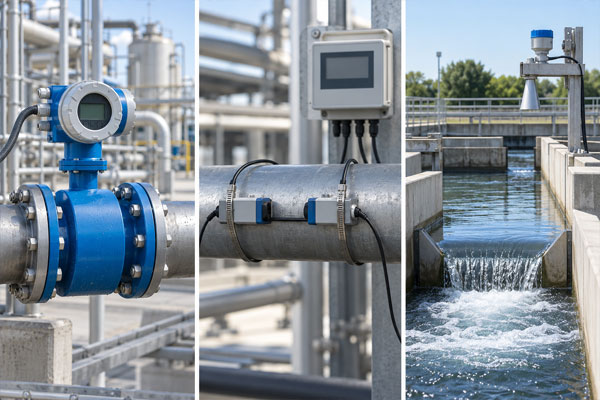
Electromagnetic vs Ultrasonic vs Open Channel Flow Meter
Water and wastewater projects do not all use the same type of flow meter. A treated water pipeline, an old municipal main, a sewage pumping line and an open effluent drain have different hydraulic and installation conditions. Selecting among electromagnetic, ultrasonic and open channel technologies requires one basic question first: is the liquid flowing through a full closed pipe or moving with a free surface?
This comparison explains how the three technologies work, where each performs well and what information to share with an Electromagnetic Flow Meter Manufacturer in India, an Ultrasonic Flow Meter Supplier in India or an Open Channel Flow Meter Manufacturer in India before ordering.
The First Decision: Full Pipe or Free Surface Flow
Electromagnetic and most inline or clamp on ultrasonic meters are primarily used on closed pipes that remain full. Open channel meters are used when liquid has a visible free surface, including weirs, flumes, drains, canals and certain partially filled conduits. Using a full pipe technology in a pipe that repeatedly runs empty can produce unstable or invalid readings.
- Full conductive pipe: consider electromagnetic measurement.
- Full pipe where nonintrusive retrofit is important: consider clamp on ultrasonic measurement.
- Open drain, canal, flume or weir: consider open channel measurement.
- Partially filled conduit: evaluate open channel or area velocity technology based on the hydraulic profile.
How an Electromagnetic Flow Meter Works
An electromagnetic meter creates a magnetic field across the measuring tube. A conductive liquid moving through that field generates a voltage at the electrodes. The measured voltage is proportional to liquid velocity, and the transmitter converts velocity and pipe area into volumetric flow.
Where It Fits Best
- Potable and process water
- Raw water and wastewater
- Conductive chemicals
- Slurries and liquids containing suspended solids
- Pumping stations, treatment plants and industrial pipelines
Main Advantages
The measuring tube has no rotor, so there is little obstruction and no mechanical bearing wear. The technology can handle many dirty or solids bearing conductive liquids. Proper liner and electrode selection allows it to serve a broad range of water and chemical applications.
Important Limitations
The liquid must meet the meter’s minimum conductivity requirement, and the pipe should remain full. Grounding, liner compatibility, electrode material and installation away from severe air entrainment are important. It is not the correct choice for most oils, fuels or demineralized liquids with very low conductivity unless the application is specifically verified.
How an Ultrasonic Flow Meter Works
Transit time ultrasonic meters send pulses both upstream and downstream. Flow changes the travel time of the sound, and the difference is used to calculate velocity. Clamp on transducers attach to the outside of the pipe, while inline versions place the acoustic path within a purpose built meter body.
Where It Fits Best
- Existing pipelines where cutting or shutdown is undesirable
- Temporary flow surveys and energy audits
- Large diameter water lines
- Cooling water, treated water and suitable process liquids
- Applications requiring minimal pressure loss
Main Advantages
Clamp on measurement is nonintrusive. It avoids wetted sensor parts, creates no additional pressure drop and can reduce installation work on an operating pipeline. Portable versions are useful for verification and troubleshooting at multiple locations.
Important Limitations
Performance depends on correct pipe data, transducer spacing, acoustic coupling and a stable full pipe. Heavy internal scaling, unsuitable pipe construction, large amounts of bubbles or an unstable flow profile can reduce signal quality. Transit time and Doppler methods serve different fluid conditions, so the correct principle must be selected.
How an Open Channel Flow Meter Works
An open channel system commonly measures liquid level above a defined point in a weir or flume. The controller converts that level into flow using the programmed relationship between head and discharge. Some applications use area velocity or radar based methods when a primary structure is not appropriate.
Where It Fits Best
- Sewage and effluent drains
- Parshall flumes and measuring weirs
- Irrigation canals and water distribution channels
- Industrial discharge monitoring
- Stormwater and partially filled flow paths
Main Advantages
The sensor can often measure without contacting the liquid. This is useful for corrosive, dirty or debris carrying flow. The method is designed for free surface conditions that closed pipe meters cannot measure correctly.
Important Limitations
Hydraulic accuracy depends on the primary element or channel geometry. Poor approach flow, deposits, backwater, submerged flumes, foam and an incorrect zero reference can create errors. Installation quality is as important as transmitter accuracy.
Direct Technology Comparison
| Selection Point | Electromagnetic | Ultrasonic | Open Channel |
| Flow Condition | Full closed pipe | Usually full closed pipe | Free surface flow |
| Fluid Requirement | Conductive liquid | Acoustically suitable liquid | Liquid compatible with channel method |
| Pipe Contact | Inline and wetted | Clamp on can be nonintrusive | Sensor can be noncontact |
| Moving Parts | None | None | None in common noncontact systems |
| Pressure Loss | Generally low | None for clamp on | Controlled by channel or primary element |
| Retrofit Ease | Requires pipe work | Strong for clamp on retrofit | Requires suitable measuring location |
| Typical Challenge | Conductivity, grounding, pipe fullness | Pipe data, coupling, bubbles, scaling | Geometry, backwater, deposits, zero setting |
Application Based Recommendations
Water Treatment Plant
Electromagnetic meters are often appropriate for conductive water lines, chemical dosing lines and sludge service when material compatibility and sizing are correct. Clamp on ultrasonic meters can support temporary checks or locations where shutdown is difficult.
Wastewater Treatment and Effluent
A full pressurized sewage line may suit an electromagnetic meter because it has no rotor to obstruct solids. An open effluent drain or flume requires open channel measurement. The presence of foam, ragging, sediment and changing hydraulic conditions should be discussed during selection.
Municipal Distribution and Large Pipelines
For permanent measurement on conductive water, electromagnetic technology is widely used. Clamp on ultrasonic measurement can reduce civil and piping work for an existing line, especially when the pipe cannot be cut. A site survey should confirm pipe material, lining, access and acoustic signal quality.
Irrigation Canal
Open channel measurement is the logical category when water flows through a canal or flume. Channel dimensions, upstream flow conditions, sediment and the available measurement structure determine the final solution.
Installation Factors That Affect Accuracy
- Keep a closed pipe meter in a location where the pipe remains full.
- Follow the manufacturer’s upstream and downstream straight run guidance.
- Avoid locations immediately after pumps, control valves or severe bends when possible.
- Use correct grounding and bonding for electromagnetic measurement.
- Enter accurate pipe outside diameter, wall thickness and material for clamp on ultrasonic setup.
- Maintain proper acoustic coupling and protect transducers from movement or weather.
- Set the correct zero reference, channel geometry and primary element data for open channel systems.
- Inspect flumes and weirs for deposits, damage, submergence and backwater effects.
Common Mistakes to Avoid
- Using a closed pipe meter where the pipe can run partly empty.
- Selecting electromagnetic technology without confirming conductivity.
- Expecting clamp on ultrasonic measurement to ignore pipe condition and setup data.
- Installing a level sensor over turbulent or foaming flow without reviewing the location.
- Programming the wrong flume, weir or channel dimensions.
- Ignoring backwater, sediment and the condition of the primary measuring structure.
- Ordering by pipe size without checking the minimum and maximum flow rate.
Conclusion
Electromagnetic, ultrasonic and open channel meters are complementary technologies. Electromagnetic measurement is a strong option for conductive liquid in a full pipe. Clamp on ultrasonic measurement can simplify retrofit and temporary monitoring. Open channel measurement is designed for liquid with a free surface. The best result comes from matching the hydraulic condition first and then confirming materials, flow range, installation and output requirements with a qualified manufacturer.
Frequently Asked Questions
Neither is universally better. Electromagnetic meters suit conductive liquids in full pipes, while clamp on ultrasonic meters are valuable when nonintrusive installation is a priority and the pipe and fluid provide a good acoustic path.
Yes, it is commonly considered for conductive wastewater and solids bearing liquid when the liner, electrodes, sizing and installation are suitable.
No. Pipe material, lining, wall thickness, internal condition, liquid properties, bubbles and available straight run influence performance.
Open channel flow has a free surface and is usually calculated from level and channel geometry. Closed pipe measurement assumes the pipe is full and uses another principle to determine velocity or volume.
Many installations use a calibrated flume or weir, but area velocity and radar based approaches may be considered for some channels. The hydraulic method must match the site.
Proper grounding provides a stable electrical reference for the very small electrode signal and helps reduce measurement noise.
Some ultrasonic methods can measure liquids containing particles, while transit time meters generally prefer cleaner acoustic conditions. The right principle depends on the amount and type of solids or bubbles.
Provide the medium, conductivity when relevant, pipe or channel dimensions, flow range, pressure, temperature, pipe material and lining, installation layout, required accuracy, power and signal output.