
Level Transmitter vs Float Level Switch
A level transmitter and a float level switch can both monitor liquid in a tank, but they provide different information. A transmitter measures level continuously and sends a variable signal to a display or control system. A switch changes state when the liquid reaches a defined point. Confusing these functions can lead to unnecessary cost, weak alarm protection or a control system that does not provide enough information.
This guide explains how each device works, where it is used and what to discuss with a Level Transmitter Manufacturer in India or Float Level Switch Manufacturer in India before selecting an instrument.
The Core Difference
A level transmitter answers the question, how much liquid is in the vessel right now? A level switch answers the question, has the liquid reached this specific point? One provides a continuous value, while the other provides a discrete status.
| Selection Point | Level Transmitter | Float Level Switch |
| Measurement | Continuous level across a range | Point detection at one or more set levels |
| Typical Output | 4 to 20 mA or digital communication | Relay, reed switch or discrete output |
| Control Use | Trend, inventory, proportional control | High, low, pump start or stop, alarm |
| Display | Can show level, percentage or volume | Usually shows only state |
| Complexity | More configuration and scaling | Generally simple |
| Typical Cost | Usually higher | Usually lower for basic point control |
| Best Role | Process visibility and continuous control | Independent protection and simple automation |
What Is a Level Transmitter?
A level transmitter measures the position of a liquid surface continuously and converts the measurement into a standard signal. The control system can display the level, calculate tank inventory, operate a control valve, trend consumption or generate alarms at multiple software set points.
Common Level Transmitter Technologies
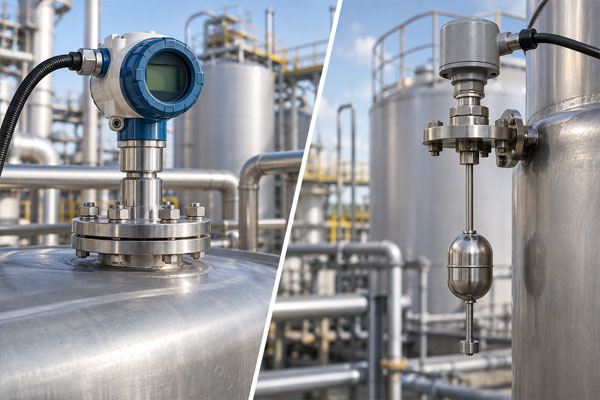
Float Level Transmitter
A float follows the liquid surface along a stem or guide. The movement is converted into an electrical signal, often 4 to 20 mA depending on the model. It is a direct and understandable method for compatible clean liquids and suitable tank geometry.
Ultrasonic Level Transmitter
An ultrasonic transmitter sends a sound pulse toward the liquid and measures the return time. Since the sensor does not need to contact the medium, it can be useful for water and wastewater. Foam, heavy vapour, turbulence, obstructions and the near sensor dead zone must be reviewed.
Radar Level Transmitter
Radar instruments use microwave signals and calculate distance from the return. They can perform well in demanding tanks, but antenna selection, internal obstructions, dielectric properties and process conditions remain important.
Capacitance Level Transmitter
A capacitance transmitter detects changes in capacitance as the process level changes around a probe. Probe construction and calibration must match the dielectric properties, tank arrangement and tendency for coating or buildup.
Hydrostatic or Differential Pressure Level Transmitter
Hydrostatic measurement infers level from the pressure created by the liquid column. Density, vessel pressure, impulse arrangement and the location of the pressure reference influence the result. It is widely used in tanks, wells and reservoirs when process conditions are understood.
What Is a Float Level Switch?
A float level switch uses buoyancy. As the liquid rises or falls, the float moves and operates a reed, magnetic or mechanical switching element. The output can start or stop a pump, open or close a valve, or trigger a high or low level alarm.
Typical Float Switch Functions
- High level alarm to prevent overflow
- Low level alarm to prevent dry running
- Pump start and stop control
- Minimum level protection for heaters or agitators
- Multiple point control using more than one float on a stem
- Simple tank filling and emptying automation
Why Float Switches Remain Popular
Float switches are simple, economical and easy to understand. They can provide a direct independent signal even when a continuous transmitter or control system is unavailable. Correct material, switch rating, mounting, float travel and liquid density are essential.
Why Many Tanks Need Both
A continuous transmitter and a point level switch can perform complementary roles. The transmitter provides normal process measurement, while a separate switch acts as an independent high high or low low protection layer. This arrangement can reduce the risk of relying on one sensor, one cable or one control logic path for every function.
For example, a transmitter can regulate tank filling between normal operating limits. A separate high level float switch can trip the inlet pump if the continuous measurement or control loop fails. The final safety design should follow the plant’s hazard assessment and engineering standards.
Selection Factors to Discuss With the Supplier
- Medium and chemical composition, including concentration and possible coating or crystallization.
- Minimum and maximum temperature and pressure.
- Tank height, diameter, shape, nozzle location and internal obstructions.
- Liquid density, dielectric property, foam, vapour, turbulence and suspended solids.
- Required measuring range, accuracy, alarm points and response time.
- Mounting position, process connection and available insertion length.
- Wetted materials such as SS304, SS316, PP, PTFE or other compatible options.
- Power supply, 4 to 20 mA, relay, reed, transistor or digital communication requirement.
- Weatherproof, flameproof or hazardous area requirements where applicable.
- Calibration, testing, drawings, certificates and commissioning support.
Application Examples
| Application | Recommended Measurement Role | Possible Instrument |
| Raw Water Tank | Continuous level plus low pump protection | Hydrostatic or ultrasonic transmitter with low level switch |
| Chemical Storage | Inventory and independent overflow alarm | Compatible radar or other transmitter with high level switch |
| Cooling Tower Basin | Pump start and stop | Float level switch or transmitter based control |
| Day Tank | Continuous consumption and high or low alarms | Float transmitter with independent switches |
| Sewage Sump | Pump sequencing and overflow protection | Noncontact transmitter plus suitable backup switch |
| Process Vessel | Continuous control | Radar, guided wave radar, capacitance or DP based solution |
When to Choose a Level Transmitter
- The operator needs to see the actual level or percentage.
- Tank inventory or consumption must be calculated.
- A control valve or variable speed pump requires continuous feedback.
- Level trends are needed for process analysis or remote monitoring.
- Several alarm points must be created in the PLC or SCADA system.
- The process requires an analog or digital measurement signal.
When to Choose a Float Level Switch
- Only a high or low level condition needs to be detected.
- A pump requires simple start or stop control.
- An independent hardwired alarm is needed.
- The application needs a cost effective point level device.
- The liquid is compatible with the float and stem materials.
- The tank has enough space for the float to move freely.
Conclusion
Choose a level transmitter when the process needs a continuous measurement, trend or proportional control signal. Choose a float level switch when the process needs a simple and reliable point alarm or on and off action. Use both when continuous control and independent protection are important. The final device should be selected from actual liquid, tank, mounting and electrical conditions rather than from tank height alone.
Frequently Asked Questions
A transmitter provides a continuous value across the measuring range. A switch changes state when the process reaches a defined point.
Yes. Its signal can be used by a controller, PLC or suitable relay system to start, stop or modulate a pump. The control logic and safety design must be engineered correctly.
A basic float switch provides point detection. A float level transmitter uses float movement to create a continuous signal and is a different instrument.
A dedicated high level switch is often used as an independent overflow alarm or trip. The required protection arrangement depends on the process hazard assessment.
No. Buoyancy, density, viscosity, solids, coating, temperature, pressure and chemical compatibility can affect operation.
Ultrasonic, radar, hydrostatic and float transmitters may all be suitable. Tank geometry, required accuracy, mounting, foam, vapour, pressure and budget determine the best fit.
It is a common analog signal in which the lower and upper current values represent the configured empty and full level points. It is widely used for industrial control integration.
Send the medium, density, temperature, pressure, tank dimensions, nozzle and internal layout, measuring range, mounting, process connection, wetted material, output and area classification.