

What to Check Before Buying a Dew Point Meter
Imagine opening a pneumatic valve on the production line, only to see liquid water spray out alongside the compressed air. This unexpected moisture can ruin sensitive paint finishes, corrode expensive factory machinery, and cause critical pneumatic tools to freeze or fail entirely. When water appears where it should not, finding the source quickly is critical to keep the plant running.
A reliable Dew Point Meter gives plant managers the exact data they need to track down moisture before it causes costly downtime. Whether you operate a small manufacturing workshop or a massive pharmaceutical facility, measuring the actual moisture content of your air lines is the only way to prove your dryers are working properly. This guide will help you identify common moisture problems, compare suitable sensor types, and prepare the right information before requesting a quote from a supplier.
Understanding Pressure Dew Point
What does this instrument actually measure? The standard dew point is the specific temperature at which water vapor turns into liquid water. In an open room, this is known as the atmospheric dew point. However, in an industrial pneumatic system, you compress the air. Squeezing air into a smaller volume concentrates the water vapor and raises the temperature at which condensation happens.
This physical change is why operators must measure the pressure dew point (PDP). A reliable dew point sensor for compressed air must accurately read this moisture level while the air remains under pressure inside the pipe. A single target dew point does not suit every application. If a system conforms to the ISO 8573-1 standard, you might require a strict PDP target based on your product. For example, a Class 1 limit demands a dew point no higher than –70 °Cdp, which is necessary for high-tech electronics. A general manufacturing line might only require a Class 4 limit of +3 °Cdp. Measuring the correct PDP guarantees that condensation will not form inside your pressurized network.
Common Problems Caused by Moisture in Air Lines
Moisture creates immediate and long-term hazards for factory equipment. If your air dryer fails or struggles to keep up with demand, the resulting water leads to several recognizable issues on the plant floor. Identifying the problem is the first step toward choosing the right monitoring tool.
| Plant Problem | Likely Cause | Practical Check or Solution |
|---|---|---|
| Rust and scale in pipework | Condensation forming continuously inside carbon steel pipes over time. | Test the main dryer outlet to ensure the PDP remains below the lowest ambient plant temperature. |
| Pneumatic cylinders freezing | Expanding air drops in temperature rapidly, freezing any existing moisture. | Verify if the current compressed air dew point meter shows moisture spikes during high-flow demand. |
| Blistering in paint booths | Liquid water passing through the spray nozzle directly onto the product. | Install a point-of-use filter and check the local branch line for trapped moisture pockets. |
| Desiccant beads breaking down | Bulk liquid water entering a desiccant dryer tower and destroying the medium. | Drain upstream receivers and inspect the water separator immediately before the dryer inlet. |
Comparing Meter Types: Handheld vs Online vs Controller
| Meter Type | Best Use | Advantages | Limitations | What the Buyer Should Verify |
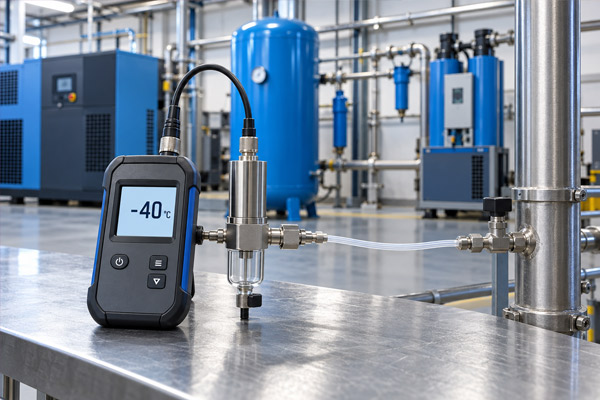
| Handheld Dew Point Meter | Spot audits, field troubleshooting, and checking multiple lines across a plant. | Highly portable, runs on battery power, and does not require permanent pipe modifications. | Cannot monitor continuous trends; relies entirely on an operator to manually take the reading. | Check the battery life, probe durability, and the quality of the quick-connect sampling hose. |
| Online Dew Point Transmitter | Continuous process monitoring 24 hours a day, 7 days a week. | Provides real-time data directly to a PLC; fits directly into the main pipework. | Requires a permanent installation and a dedicated 24 VDC power supply. | Confirm the thread size, such as ¾” BSP, and the output signal type, such as 4–20 mA or RS-485. |
| Dew Point Controller | Operating air dryers directly or triggering remote plant alarms. | Features built-in relays, an OLED LCD display, and multi-sensor data processing. | Typically needs panel mounting and a dedicated power line of 90–260 VAC. | Ensure the relay capacity matches the alarm or automatic valve you want to control. |
Key Selection Factors for Your Plant
Measurement Range
Different air dryers achieve different moisture levels. A standard refrigerant dryer usually delivers a +3 °Cdp. However, a desiccant dryer used in plastics, additive manufacturing, or pharmaceuticals pushes the dew point down much further. Ensure the sensor covers your full expected range. For instance, high-quality models offer a scalable measuring range from –100 °Cdp to +60 °Cdp to cover almost any industrial scenario.
Operating Pressure Compatibility
The sensor probe must safely withstand the maximum pressure of your air line. Connecting a low-pressure sensor to a high-pressure system will cause dangerous air leaks or completely destroy the sensitive probe. Always match the sensor’s maximum pressure rating to your compressor’s output.
Sample Point Arrangement
You can mount an online dew point transmitter directly into the main pipe or use a dedicated sampling block. Sampling blocks isolate the sensor from the main flow. This makes it much easier for technicians to remove the sensor for annual maintenance without shutting down the entire air line. Standard industrial connections usually feature a ¾” BSP male thread.
Response Time and Sensor Protection
A fast sensing time is crucial for catching sudden moisture spikes. If the dryer fails, the sensor should react quickly enough to trigger an alarm before wet air reaches sensitive machines. Additionally, industrial air often contains microscopic dust or trace oil vapor. Look for models equipped with robust physical protection, such as an S.S. 316 stainless steel filter, to prevent the sensitive measuring element from fouling prematurely.
Outputs, Display, and Plant Integration
Decide how you want to read the data. Modern transmitters send standard analog outputs (4–20 mA) or use digital communication (RS-485 Modbus RTU) to feed data directly into your SCADA system. If you want a clean installation, a Dew Point Transmitter Blind hides away in the pipework and sends data to the control room. If operators need to see the data on the floor, choose a model with a built-in display or a complete Dew Point Controller.
Maintenance and Calibration
Over time, continuous exposure to contaminants causes even the best sensors to drift. Plan for annual calibration and verify that the filter can be cleaned or replaced easily during routine maintenance.
Where to Measure Dew Point and Common Sampling Mistakes
Selecting the right instrument is only half the job. Where you install it determines the accuracy of your readings.
The most common location for a dew point meter for air dryer applications is immediately downstream of the dryer unit. This checks the performance of the dryer itself before the air travels out into the plant. However, if your facility spans multiple buildings, you should also install secondary sensors near critical point-of-use machines to ensure moisture is not entering through degrading underground pipes.
Avoid installing sensors in “dead legs”—sections of pipe where air does not flow regularly. The sensor needs moving air to provide an accurate reading. Additionally, never install a pressure dew point sensor downstream of a pressure regulator without accounting for the pressure drop. Expanding air artificially lowers the dew point reading, giving operators a false sense of security.
Illustrative Example: Protecting a Medical Molding Process
Scenario: A specialized facility uses compressed air to blow-mold medical-grade plastics.
Problem: Any moisture in the air causes structural weakness in the final plastic parts. The engineering team currently uses a portable unit to check the air once a week, but they discovered a rejected batch that occurred between their manual tests.
Solution: The team switches to a continuous online Dew Point Controller (similar to the AIDP24C model). They mount the sensor in the main feed line and wire the controller’s relays directly to an automatic shut-off valve.
Result: If the desiccant dryer fails and the moisture level climbs above the strict –40 °Cdp setpoint, the controller instantly stops the airflow. This automated response saves the plastic batch from contamination and immediately alerts the maintenance team.
What to Share When Requesting a Dew Point Meter Quote
To get the right equipment from a trusted dew point meter supplier in Ahmedabad or elsewhere, gather your system specifications first. Provide these exact details in your initial request to ensure the supplier recommends the correct model:
- Target dew point range (e.g., –40 °Cdp or +3 °Cdp)
- Type of air dryer currently used (refrigerant or desiccant)
- Maximum operating pressure of the air line
- Pipe connection size and type (e.g., ¾” BSP Male)
- Preferred power supply (24 VDC for transmitters, or AC mains for controllers)
- Required outputs (4–20 mA, RS-485 Modbus, or physical mechanical relays)
- Choice between handheld, blind fixed, or local display models
Conclusion
Choosing the right moisture monitoring equipment protects your factory from unseen corrosion, frozen valves, and costly product defects. By understanding your required pressure dew point and matching it with the right type of sensor—whether it is a simple portable unit for weekly audits or an automated controller for continuous protection—you keep your compressed air system running cleanly and efficiently.
When you are ready to upgrade your facility’s instrumentation, review Aranka Instruments’ complete Dew Point Meter & Transmitters category to find a sensor built for your exact industrial requirements.
FAQs
To choose correctly, check the lowest moisture level your specific process requires and match it to the sensor’s measurement range. Decide if you need continuous PLC data using an online transmitter or if periodic, manual checks with a handheld device are sufficient for your maintenance routine.
Buy a fixed transmitter if you need 24/7 monitoring, automated alarms, or digital data logging for a critical manufacturing process. Choose a handheld device if your maintenance team needs to troubleshoot multiple different air lines, audit various zones, or verify dryer performance across a large facility.
An air dryer removes moisture, but it cannot automatically alert you when its internal components fail. Installing a dedicated sensor at the dryer outlet verifies that the equipment is actually producing dry air, preventing bulk water from traveling downstream and damaging pneumatic cylinders or expensive end products.
Yes, operating pressure heavily influences moisture behavior in a pneumatic system. A sensor must read the pressure dew point at the actual line pressure to provide useful data. Always ensure the meter you select is rated to safely withstand the maximum pressure spikes of your specific compressed air network.
Industrial transmitters connect to plant systems using standard wiring protocols. Most units offer a standard 4–20 mA analog output for direct continuous scaling. Advanced models also use RS-485 Modbus RTU communication to send precise digital moisture and temperature data straight to your central PLC or SCADA panel.
For most industrial applications, you should plan to calibrate your sensor once a year. Continuous exposure to trace compressor oils, microscopic dust, and varying humidity levels causes the sensing element to drift slightly over time. Regular annual calibration ensures your alarms remain highly accurate.
Before asking for a quote, record your required measurement range, maximum line pressure, and pipe connection thread size. State whether you need a portable or fixed unit, specify your available power supply, and note if you require digital displays, mechanical relays, or specific Modbus outputs.