
Why Flow Meter Troubleshooting Matters
Every plant has flow meters, and every plant has flow meter problems. The reading goes off. The output goes to zero. The signal is noisy. The calibration drifts. These problems stop production, ruin batches, and cause wrong billing. Most of them are easy to fix once you know where to look.
After working with hundreds of flow meters in water, gas, steam, and chemical plants, the same set of problems keeps coming up again and again. We have put them into a list of the 10 most common flow meter problems with simple, field-tested solutions for each one.
This guide is written for operators, technicians, and engineers. We will keep the language simple, the steps clear, and the advice practical. By the end, you will be able to spot and fix most flow meter problems on your own — without calling an instrument engineer for every small issue.
Problem 1: Flow Meter Reading Zero
Symptom: The flow meter shows 0 even though fluid is moving in the pipe.
Likely Causes & Fixes:
- Empty Pipe: Check the pipe. The pipe must be full of liquid for most meters to read. Fix the piping if the meter is at a high point.
- No Power: Check the power supply, fuse, and circuit breaker. Use a multimeter to confirm voltage at the meter terminals.
- Bad Wiring: Open the junction box and check all connections. Look for loose wires, corrosion, or water ingress.
- Clogged Strainer: A clogged strainer on the suction side stops flow. Clean the strainer.
- Failed Sensor: If the above are fine, the sensor may have failed. Replace or service the sensor.
Problem 2: Flow Meter Reading High or Low
Symptom: The reading is far from what you expect — either much higher or much lower.
Likely Causes & Fixes:
- Old Calibration: Calibrate the meter. A 3% to 5% drift is common after one year.
- Air in the Line: Air bubbles cause the meter to read low or jump around. Bleed the line or install an air release valve upstream.
- Coated Electrodes (Mag Meter): Coatings insulate the electrodes. Clean with a soft brush and a manufacturer-approved cleaner.
- Bad Straight Pipe: Too close to a valve or elbow disturbs the flow profile. Add straight pipe or move the meter.
- Partial Blockage: A partial blockage in the pipe or strainer changes the velocity. Inspect and clean.
Problem 3: Flow Meter Drift Over Time
Symptom: The reading was right last year, but slowly drifted up or down.
Likely Causes & Fixes:
- Sensor Wear: Electrodes, lining, and sensors wear out. Replace worn parts.
- Coating Build-up: A thin coating of oil, scale, or bio-film can grow over time. Clean the sensor yearly.
- Electronics Aging: Old electronics drift. Recalibrate or replace the transmitter.
- Operating Conditions Changed: Higher temperature, new fluid, higher solids. Check if the meter is still suitable.
Problem 4: Air or Gas in the Liquid Line
Symptom: Reading jumps around, reads high, reads low, or goes negative.
Likely Causes & Fixes:
- Air Leak on Suction: Tighten flanges, replace gaskets. Check the pump suction.
- Air Trapped at High Point: Move the meter away from a high point, or install an air release valve upstream.
- Cavitation in the Pump: Cavitation pumps release bubbles that pass through the meter. Fix the pump suction conditions.
- Open Tank with Falling Liquid: Splash creates air bubbles. Use a stilling well or a baffle.
Problem 5: Empty Pipe Reading
Symptom: The flow meter reads even when the pipe is empty.
Likely Causes & Fixes:
- Empty Pipe Detection Not Working: Most mag meters have an empty pipe detection feature. Check that it is turned on and the electrodes are clean.
- Mounting Angle Wrong: Mag meters should be mounted at a low point where the pipe stays full. Move the meter to a better location.
- Process Drains the Line: If the line drains often, install a U-shaped section or a non-return valve to keep the pipe full.
Problem 6: No Output Signal
Symptom: The DCS / PLC shows zero or “signal fail” from the flow meter.
Likely Causes & Fixes:
- Power Supply Failure: Check the power at the meter. Many meters need 24 VDC or 110/230 VAC.
- Wiring Error: Check signal wires, shield, and ground. Many signal losses are caused by bad wiring.
- Output Card Failure: Test the 4-20 mA or pulse output with a multimeter. Replace the output card if needed.
- Sensor Failure: The flow sensor itself has failed. Replace or repair.
Problem 7: Vibration and Noise on the Reading
Symptom: The flow reading is noisy or vibrating, especially at low flow.
Likely Causes & Fixes:
- Pump Pulsation: A reciprocating or diaphragm pump creates pulses. Install a pulsation dampener or move the meter further from the pump.
- Pipe Vibration: Loose pipe supports cause vibration. Tighten the supports and add pipe clamps near the meter.
- Cavitation in the Line: Cavitation causes vibration and noise. Fix the suction side and check NPSH.
- Electrical Noise: VFDs and large motors create electrical noise. Use shielded cables and proper grounding.
Problem 8: Bad Grounding (Mag Meter Specific)
Symptom: The mag meter reading drifts, is unstable, or is consistently wrong.
Likely Causes & Fixes:
- No Ground Ring or Ground Electrode: Mag meters need a ground connection. Install a ground ring or use a meter with a ground electrode.
- Different Earth Potentials: Pipe and meter ground at different points. Use the same ground point for both.
- Plastic Pipe Without Ground: A plastic pipe does not conduct. Add ground rings on both sides of the meter.
Problem 9: Wrong Straight Pipe Length
Symptom: Flow meter reading is off, especially at low flow or when the valve is throttled.
Likely Causes & Fixes:
- Too Little Upstream Pipe: Most meters need 5 to 10 diameters of straight pipe upstream, and 3 to 5 downstream. Add straight pipe or use a flow conditioner.
- Two Elbows in Different Planes: Two elbows out of plane disturb the flow profile badly. Add 10 to 20 diameters of straight pipe.
- Valve Too Close: A control valve just before the meter creates swirl. Move the meter or add straight pipe.
Problem 10: Old or No Calibration
Symptom: The meter is over a year old and has not been calibrated. Readings are slowly drifting.
Likely Causes & Fixes:
- Set Up a Calibration Schedule: Calibrate once a year. Custody transfer and billing meters every 6 months.
- Use a NABL Lab: For ISO audits, the calibration must be from a NABL accredited lab.
- Compare with Another Meter: If you have two meters on the same line, compare them. The one that drifts more likely needs calibration.
- Replace the Meter: If a meter is more than 10 years old and the parts are obsolete, replacement is often cheaper than repair.
Quick Symptom-to-Fix Table
Here is a quick lookup table for fast troubleshooting.
| Symptom | First Check | Second Check | Final Check |
|---|---|---|---|
| Reading Zero | Check whether the pipe is full and power is on | Inspect the wiring and fuse | Check the sensor and output card |
| Reading High or Low | Check the calibration | Check for air in the line or sensor coating | Check straight pipe length and blockage |
| Reading Drifts | Check the calibration age | Inspect for coating or sensor wear | Review the operating conditions |
| No Signal to DCS | Check the power supply | Inspect the wiring and cable shield | Check the output card and sensor |
| Noisy Reading | Check for pump pulsation | Inspect pipe vibration | Check for electrical noise |
| Mag Meter Unstable | Check grounding | Check empty pipe detection | Inspect for electrode coating |
| Vortex Reads Low | Check for low flow velocity | Check pipe vibration | Inspect the sensor condition |
Best Practices to Avoid Flow Meter Problems
- Install at the Right Location: Pick a place with a full pipe, straight runs, and no air pockets.
- Use the Right Meter Type: Match the meter to the fluid and the application.
- Ground the Meter Properly: For mag meters, use ground rings or ground electrodes.
- Calibrate Every Year: Set up a yearly calibration plan with a NABL lab.
- Clean the Sensor Yearly: Open the meter once a year and clean the lining and electrodes.
- Keep Records: Log every calibration, cleaning, and repair. Trends tell you when to replace a meter.
- Train Operators: A well-trained operator spots problems early and saves the meter.
When to Call an Expert
Call Aranka Instruments if:
- The basic checks do not fix the problem.
- You suspect the sensor is failed or coated beyond cleaning.
- You need a NABL accredited calibration for ISO audits.
- You need to replace the meter with a new one for a different fluid or higher accuracy.
Conclusion
Flow meter problems are common, but most of them are easy to fix. Start with the basics — power, wiring, pipe fill, and air. Then check installation, calibration, and grounding. Use the symptom-to-fix table in this guide to find the cause fast. A small habit of regular cleaning and yearly calibration keeps most flow meters healthy for many years. When in doubt, call an instrument expert like Aranka Instruments for help.
Frequently Asked Questions (FAQs)
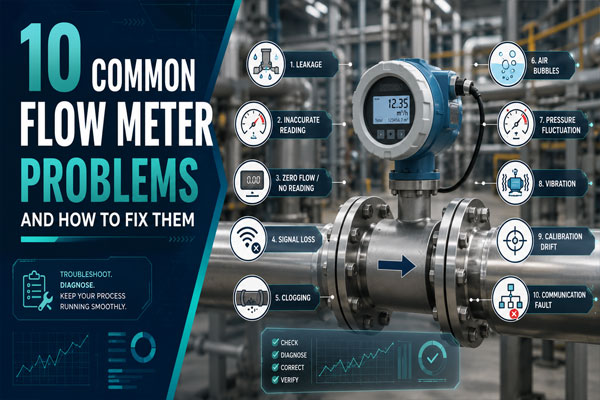
The most common flow meter problems are wrong readings, no output, drifting readings, air in the line, coated electrodes, empty pipe, vibration, bad grounding, wrong straight pipe length, and old calibration.
The most common reasons are empty pipe, no power, bad wiring, a clogged strainer, an air-locked line, or a failed sensor. Check the basics first: power, wiring, and pipe fill.
A flow meter can read high or low because of wrong calibration, air in the line, coated electrodes, bad straight pipe, vibration, or a partial blockage. Check installation and run a calibration check.
Check the empty pipe, electrode coating, grounding, wiring, power supply, and pipe fill. Most mag meter problems are electrical, not mechanical.
Check for low flow, vibration, mounting, straight pipe length, and sensor condition. Vortex meters need a minimum flow velocity and a vibration-free installation.
Most flow meters should be cleaned at least once a year. In dirty, oily, or scaling service, clean every 3 to 6 months. Always follow the maker’s cleaning instructions.
Repair if the meter is less than 5 years old and parts are available. Replace if the meter is more than 10 years old, parts are obsolete, or it has failed multiple times in a year.