
Radar and Ultrasonic Level Transmitters
Level measurement is one of the most common jobs in any plant. Two of the most popular non-contact technologies used today are the radar level transmitter and the ultrasonic level transmitter. Both sit on top of the tank, send a signal down to the liquid surface, and measure the level from the time the signal takes to come back.
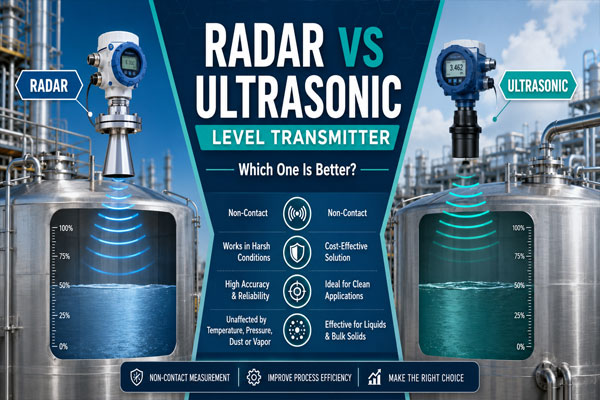
The two technologies look similar from the outside, but they are very different inside. Radar uses microwave signals. Ultrasonic uses sound waves. This single difference decides where each one works, how accurate it is, and how much it costs.
In this guide, we compare radar vs ultrasonic level transmitters in simple words. We will cover how they work, where each one fits best, their accuracy, cost, and the common problems they solve. By the end, you will know which one is the right choice for your tank.
How Does a Radar Level Transmitter Work?
A radar level transmitter sends a microwave pulse from the antenna at the top of the tank. The pulse travels down at the speed of light, hits the liquid surface, and bounces back. The transmitter measures the time of flight and calculates the distance to the surface. From the total tank height, it shows the level.
There are two main types of radar:
- Non-Contact Radar (FMCW or Pulsed): The antenna is in open air, no contact with the liquid. Best for clean liquids and harsh conditions.
- Guided Wave Radar (GWR): The signal travels along a probe (rod or cable) dipped in the liquid. Best for low dielectric liquids and short tanks.
Microwaves are not affected by vapor, dust, foam, or temperature. That is why radar works in steam, hot oil, and chemical reactors.
How Does an Ultrasonic Level Transmitter Work?
An ultrasonic level transmitter sends a sound wave (usually 20 to 200 kHz) from a sensor at the top of the tank. The sound wave travels down through the air, hits the liquid surface, and bounces back. The transmitter measures the time of flight and calculates the level.
Because sound is a mechanical wave, it is affected by air temperature, vapor, dust, and foam. Ultrasonic works best in clean air, short ranges, and small to medium tanks.
Key Differences Between Radar and Ultrasonic Level Transmitters
Let us compare the two technologies across the features that matter most.
| Feature | Radar Level Transmitter | Ultrasonic Level Transmitter |
|---|---|---|
| Signal Type | Microwave (GHz) | Sound wave (kHz) |
| Accuracy | ±1 mm to ±5 mm (high) | ±0.2% to ±0.5% of range (medium) |
| Maximum Range | Up to 40 m (non-contact) and 6 m (GWR) | Up to 15 m (typical) |
| Effect of Temperature | None (built-in compensation) | High (requires temperature compensation) |
| Effect of Vapor or Steam | None | Strong (signal may be absorbed) |
| Effect of Foam | Small (with FMCW radar) | Strong (signal may be scattered) |
| Effect of Dust | None | Medium |
| Effect of Agitation | Small (with dynamic algorithms) | Medium |
| Cost | Higher (around 3 to 5 times ultrasonic) | Lower |
| Maintenance | Very low | Low to medium (sensor face requires cleaning) |
| Best For | Harsh conditions, high accuracy and long-range measurement | Simple, clean and low-cost applications |
Benefits of Radar Level Transmitters
- Very high accuracy: ±1 mm is possible with high-end radar.
- Works in harsh conditions: Foam, vapor, dust, and temperature changes do not affect the signal.
- Long measuring range: Up to 40 m for non-contact radar.
- Low maintenance: No moving parts, no contact with the liquid, no drift over time.
- Reliable in custody transfer: Used in oil, gas, and chemical tanks for inventory management.
Benefits of Ultrasonic Level Transmitters
- Low cost: 30% to 50% of a radar transmitter.
- Simple to install: Just a flange or thread on top of the tank.
- Easy to set up: Most have push-button or menu calibration.
- Good for simple jobs: Water tanks, sumps, and open channels work well.
- No contact with the liquid: No risk of corrosion or coating.
Where Radar Level Transmitters Work Best
Radar is the right choice in these conditions:
- Steam drums and hot oil tanks: Temperature and vapor would kill an ultrasonic.
- Chemical reactors with agitators: Foam and turbulence do not affect radar.
- Custody transfer of oil and chemicals: High accuracy (±1 mm) for inventory.
- Liquid gas (LPG, LNG) tanks: Low dielectric and cryogenic service.
- Wastewater and sludge tanks: Foam and vapor present.
- Cement, fly ash, and bulk solids: Long range and dust tolerance.
Where Ultrasonic Level Transmitters Work Best
Ultrasonic is the right choice in these conditions:
- Clean water tanks: Drinking water, RO water, DM water.
- Open sumps and small pits: Short range and clear air.
- Open channel flow measurement: With a flume or weir.
- Cooling water tanks: At normal temperature and low vapor.
- Cost-sensitive applications: Where accuracy of ±1 cm is enough.
Common Problems Solved by Radar and Ultrasonic
Here is how each technology solves real plant problems.
Problems Solved by Radar:
- Problem: Ultrasonic reads wrong in a steam drum. Foam and vapor kill the signal.
Solution: Switch to a non-contact radar. Microwaves pass through vapor without loss. - Problem: Sludge tank level is not accurate due to thick foam.
Solution: Use a guided wave radar. The probe cuts through the foam and reads the actual sludge surface. - Problem: Inventory measurement must be within ±1 mm.
Solution: Use a high-end FMCW radar with HART or Fieldbus output. - Problem: Level sensor keeps failing in a hot oil tank at 250°C.
Solution: Use a high-temperature radar with a process seal and cooling fins.
Problems Solved by Ultrasonic:
- Problem: A small water tank needs a level indicator at low cost.
Solution: Use an ultrasonic level transmitter. It is simple, cheap, and accurate enough. - Problem: An open sump needs level control for pump start-stop.
Solution: Use an ultrasonic sensor with relay output. It is a one-hour install. - Problem: An open channel needs flow measurement without contact.
Solution: Use an ultrasonic sensor with a flume or weir for flow calculation.
Installation Tips for Radar and Ultrasonic
For Radar
- Mount the antenna vertically, with a clear path to the surface.
- Keep the antenna away from the tank wall by at least 1/6 of the tank diameter.
- Avoid mounting directly above agitator shafts or inlet streams.
- Use a stilling well or a sight glass for very turbulent liquids.
For Ultrasonic
- Mount the sensor vertically, with no obstructions in the beam path.
- Keep the sensor at least 0.3 m above the highest expected level (dead band).
- Install a sunshade if the tank is outdoors. Direct sunlight heats the sensor face and causes drift.
- Avoid mounting near air curtains, fan inlets, or steam vents.
Cost Comparison: Radar vs Ultrasonic
Here is a simple cost guide. Prices are approximate and depend on the brand, output and selected options.
| Type | Price Range (Per Unit, India) | Best For |
|---|---|---|
| Basic Ultrasonic, 4–20 mA Output | ₹15,000 – ₹40,000 | Simple water tanks and sumps |
| Advanced Ultrasonic, HART, Large Range | ₹40,000 – ₹90,000 | Open channels and water treatment plants |
| Basic Non-Contact Radar | ₹60,000 – ₹1,50,000 | General industrial tanks |
| High-End FMCW Radar, HART or Fieldbus | ₹1,50,000 – ₹4,00,000 | Custody transfer and harsh industrial service |
| Basic Guided Wave Radar | ₹80,000 – ₹2,00,000 | Interface measurement, slurry and low-dielectric media |
When to Choose Radar Over Ultrasonic
Pick radar if any of the following apply:
- You need accuracy better than ±0.5%.
- The process has foam, vapor, dust, or high temperature.
- The tank is more than 10 meters tall.
- You measure low dielectric liquids like oil, LPG, or LNG.
- You need custody transfer accuracy for inventory.
- You want a maintenance-free sensor for 10+ years.
When to Choose Ultrasonic Over Radar
Pick ultrasonic if:
- The fluid is water or a similar clean liquid.
- The tank is short and the range is under 10 m.
- The air above the liquid is clean, no vapor or dust.
- Cost matters more than the last 1% of accuracy.
- You need a quick install with simple wiring.
Hybrid Approach: Both in the Same Plant
Many plants use both technologies. They put ultrasonic on simple water tanks and sumps, and radar on process tanks, custody tanks, and reactors. This gives them the right balance of cost and performance.
How Aranka Instruments Can Help
At Aranka Instruments, we help plants pick the right level instrument for their tank. We supply radar level transmitters from leading brands, ultrasonic sensors for water and wastewater, and guided wave radar for interface and slurry. We also help with installation, calibration, and after-sales service across India.
Conclusion
The choice between radar vs ultrasonic level transmitter is not about which one is “better” in general. It is about which one is right for your tank. Radar wins on accuracy, harsh service, and long range. Ultrasonic wins on cost, simplicity, and clean water jobs. Many plants use both. Match the technology to your fluid, tank, and accuracy need, and you will get a level measurement that runs quietly for many years.
Frequently Asked Questions (FAQs)
Radar level transmitters use microwave signals, while ultrasonic level transmitters use sound waves. Both are non-contact. Radar is more accurate and works in harsh conditions like foam, vapor, and dust. Ultrasonic is cheaper but is affected by foam, vapor, and temperature.
Radar is better for harsh conditions, high accuracy, and long range. Ultrasonic is better for clean, simple applications where cost matters and accuracy is not critical.
No. Ultrasonic transmitters cannot measure reliably through heavy foam because the foam absorbs or scatters the sound wave. Radar is much better in foamy service.
Yes. Radar works in steam, vapor, and dust. The microwave signal is not affected by air, vapor, or temperature. This is why radar is used in steam drums, hot oil tanks, and chemical reactors.
A basic ultrasonic level transmitter costs about 30% to 50% of a radar transmitter. A high-end radar with HART or FOUNDATION Fieldbus costs more. Over the long term, radar often gives a better return because of higher accuracy and lower maintenance.
Yes, but a non-contact radar may struggle with very low dielectric liquids. For oil, LPG, LNG, and similar fluids, a guided wave radar (GWR) is the best choice. The probe focuses the signal and gives a strong return even from low dielectric fluids.
Both technologies last 10 to 15 years in normal service. Radar tends to last longer in harsh service because it has no moving parts and is less affected by the environment. Ultrasonic sensors may need cleaning every 1 to 2 years.