
Why Flow Meter Calibration Matters
Every flow meter on a plant floor drifts over time. Sensors wear, lining gets coated, electrodes get corroded, and electronics age. The result is the meter reading slowly goes off — sometimes high, sometimes low. In some plants, a 3% drift is common after just one year. In harsh service, the drift can be 5% or more.
This is why flow meter calibration is so important. Calibration is the only way to know if your meter is still reading correctly. A calibrated meter protects your revenue, your process quality, and your audit compliance. An uncalibrated meter can cost your company a lot of money without anyone noticing.
This guide explains flow meter calibration procedure, how often you should do it, the main methods, and why it matters for every plant. We have written it in simple English so engineers, technicians, and managers can all understand it.
What Is Flow Meter Calibration?
Flow meter calibration is the process of comparing the readings of a flow meter with a known reference standard under controlled conditions. If the meter reading is off, the technician adjusts the meter (or applies a correction factor) so that the reading is accurate.
Calibration is not the same as verification. Verification just checks if the meter is still within its stated accuracy. Calibration actively adjusts or corrects the meter to bring it back to standard.
Why Flow Meter Calibration Is Important
There are four big reasons to calibrate flow meters on time.
- Accurate Billing: If you buy or sell water, steam, gas, or chemicals by flow, an uncalibrated meter can cost lakhs of rupees every year.
- Process Quality: Many processes need an exact ratio of ingredients. A wrong flow reading ruins the product.
- Energy and Mass Balance: Plant engineers use flow data to track energy use. A drift of 3% can hide a real loss of 5% somewhere else.
- Audit Compliance: ISO 9001, ISO 14001, ISO 17025, and other standards require proof of calibration. No certificate, no audit pass.
Common Flow Meter Calibration Methods
Flow meter calibration is the process of comparing the readings of a flow meter with a known reference standard under controlled conditions. If the meter reading is off, the technician adjusts the meter (or applies a correction factor) so that the reading is accurate.
Calibration is not the same as verification. Verification just checks if the meter is still within its stated accuracy. Calibration actively adjusts or corrects the meter to bring it back to standard.
1. Gravimetric Method
The fluid flows into a tank on a precision scale. The weight is measured over a known time. The flow rate is calculated from weight and time. This is the most accurate method and is used by national labs.
2. Volumetric Method
The fluid flows into a tank of known volume, or a pipe of known volume with a piston. The flow rate is calculated from volume and time. It is accurate and widely used in commercial labs.
3. Master Meter Method
A reference flow meter (the “master meter”) that has been calibrated in a lab is connected in series with the meter being tested. Both readings are compared. This is fast and good for on-site work.
4. Comparison with a Reference Instrument
The flow meter is connected in line with another accurate instrument such as a Coriolis meter, a calibrated mag meter, or a reference DP transmitter. Readings are compared at multiple flow points.
5. Wet Calibration vs Dry Calibration
Wet calibration uses real fluid flow. Dry calibration checks electronics only (sensor simulation). Dry calibration is faster and cheaper, but wet calibration is more reliable for ISO and custody transfer.
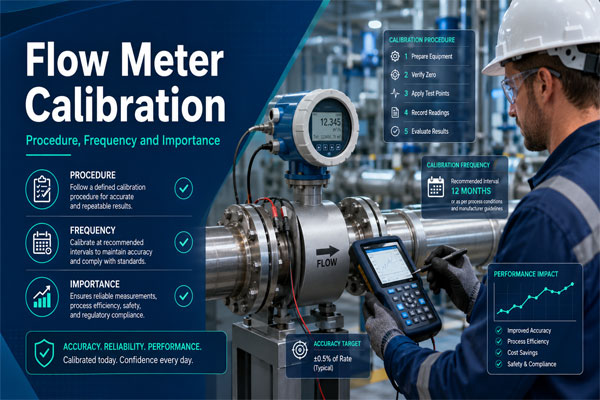
Flow Meter Calibration Procedure (Step by Step)
Here is a typical wet calibration procedure for a mag, vortex, or Coriolis flow meter. The exact steps may change by meter type, but the idea is the same.
- Pre-calibration Check: Inspect the meter for damage, lining wear, electrode coating, or build-up. Clean the meter before calibration.
- Set Up the Test Loop: Connect the meter to a calibration rig with a known reference (gravimetric, volumetric, or master meter).
- Stabilize the System: Run the flow for a few minutes to remove air and reach steady state.
- Run Multiple Flow Points: Test at least 3 to 5 flow points: low, mid, high, and any critical operating point.
- Record Readings: Note the meter reading and the reference reading at each flow point.
- Calculate Error: Error (%) = (Meter Reading – Reference Reading) / Reference Reading × 100
- Adjust the Meter: If the error is more than the allowed limit, adjust the meter factor or trim the K-factor to bring the reading within spec.
- Repeat the Test: Re-check the meter at the same flow points after adjustment.
- Issue the Certificate: Prepare a calibration certificate with the meter details, reference standard, flow points, error, and pass/fail status.
How Often Should You Calibrate a Flow Meter?
The general rule is once a year. But the right answer depends on:
- Type of fluid: Dirty or abrasive fluids need more frequent calibration.
- Operating conditions: High temperature, pressure, or corrosive service ages the meter faster.
- Accuracy need: Custody transfer and billing meters need calibration every 6 months.
- Audit rules: ISO 17025 labs require yearly calibration with traceability.
As a simple rule of thumb:
- Custody transfer / billing meters: Every 6 months
- Critical process meters: Every 6 to 12 months
- General plant meters: Every 12 months
- Indicating-only meters: Every 12 to 24 months
Typical Calibration Accuracy Standards
Different applications need different accuracy levels. Here is a quick guide.
| Application | Typical Required Accuracy | Calibration Frequency |
|---|---|---|
| Custody Transfer (Oil, Gas and Steam) | ±0.3% to ±0.5% | Every 6 months |
| Billing of Water and Utilities | ±1% | Every 12 months |
| Process Control (Chemicals and Food) | ±1% to ±2% | Every 12 months |
| General Plant Monitoring | ±2% to ±5% | Every 12 to 24 months |
| Compressed Air and Utilities | ±3% to ±5% | Every 12 months |
Common Problems in Flow Meter Calibration
- Air in the line: Air bubbles give wrong readings. Bleed the line before calibration.
- Pulsating flow: Pumps that pulse (like diaphragm pumps) make calibration hard. Use a pulsation dampener or steady reference flow.
- Wrong straight pipe: If the meter is too close to a valve or elbow, the flow profile is bad. Fix the installation first.
- Dirty or coated sensor: A mag meter with coated electrodes reads low. Clean the sensor before calibration.
- Temperature not stable: Calibration must be done at a stable temperature. Drifting temperature causes drift in the reference too.
Problems Solved by Timely Flow Meter Calibration
Here is how proper calibration solves real plant problems.
- Problem: Plant buys more raw material than the flow meter shows. Losses are unexplained.
Solution: Calibrate the inlet flow meter. A 3% drift over a year can mean a lot of lost material. - Problem: Steam bills from the utility are higher than the in-house meter.
Solution: Calibrate both meters on the same loop. The drift on one side often comes out in the open. - Problem: ISO auditor flags the calibration certificates as outdated.
Solution: Set up a yearly calibration schedule with a NABL lab. Keep all certificates on file. - Problem: Batch product quality varies even when setpoints are the same.
Solution: Calibrate the dosing flow meters. A 2% error on a dosing line gives very different product. - Problem: Custody transfer audit shows the meter is out of spec.
Solution: Calibrate every 6 months and re-certify with a NABL lab.
On-Site vs Lab Calibration
| Feature | On-Site Calibration | Lab Calibration |
|---|---|---|
| Accuracy | ±1% to ±2% | ±0.1% to ±0.5% |
| Cost | Lower | Higher |
| Time | A few hours | Days to weeks |
| Best For | Quick checks and process meters | Custody transfer and ISO audits |
| Equipment Needed | Portable calibrator and master meter | Gravimetric or volumetric calibration rig |
| Traceability | Yes, if the master meter is traceable | Yes, with NABL or ISO/IEC 17025 traceability |
How Aranka Instruments Can Help
At Aranka Instruments, we help plants with their flow meter calibration needs. We offer on-site calibration, lab calibration through NABL-accredited partners, and full asset management programs. We also supply new flow meters and repair or replace units that are no longer accurate.
Conclusion
Flow meter calibration is not a luxury — it is a must. A flow meter that is not calibrated is just a guess. Calibration protects your billing, your product quality, your energy balance, and your audit compliance. Calibrate at least once a year, more often for custody transfer and harsh service. Use a NABL accredited lab, and keep all certificates in one place. A small annual cost for calibration can save lakhs of rupees in lost product and rejected batches.
Frequently Asked Questions (FAQs)
Flow meter calibration is the process of comparing a flow meter’s reading against a known reference standard. The result is used to adjust the meter so that its reading is accurate.
Most flow meters should be calibrated once a year. Custody transfer and billing meters may need calibration every 6 months. Critical process meters may need it every 3 months.
Calibration is important for accurate billing, ISO and audit compliance, process quality, and energy balance. An uncalibrated flow meter can drift by 2% to 5% or more, leading to revenue loss and product quality issues.
The most common method is to compare the flow meter against a master reference. This is done using a gravimetric method (weighing the fluid), a volumetric method (measuring a known volume), or a master meter method (using a calibrated reference meter).
Yes. Many flow meters can be calibrated on-site using a portable calibrator or a master meter inserted in the line. For ISO 17025 accredited calibration, the meter is usually sent to a lab.
NABL is the National Accreditation Board for Testing and Calibration Laboratories in India. A NABL accredited lab follows ISO 17025 standards, and its certificates are accepted in audits worldwide.
On-site calibration takes 2 to 4 hours per meter. Lab calibration takes 5 to 10 working days, including transit time. For urgent cases, express calibration is available at higher cost.