
Conductivity TDS Meter Manufacturer in Ahmedabad
Water quality monitoring is critical for industries ranging from pharmaceutical manufacturing to beverage production. A conductivity TDS meter is a fundamental instrument for measuring the quality and purity of water. Whether you need a reliable conductivity TDS meter manufacturer or supplier in Ahmedabad, understanding how these devices work and how to select the right one is essential for your operations.
The Problem: Why Water Quality Matters
- Contaminated or impure water can ruin product batches and damage equipment
- Non-compliant water quality leads to regulatory violations and costly penalties
- Manual testing is slow and unreliable for continuous monitoring
- Inadequate water treatment increases maintenance costs and equipment downtime
The solution? Invest in a high-quality conductivity TDS meter from a trusted manufacturer in Ahmedabad that provides accurate, real-time measurements for continuous quality control.
What is a Conductivity TDS Meter? Complete Definition
Conductivity Meter:
Measures the ability of water to conduct electric current, which is determined by the concentration of dissolved salts and ions. Higher conductivity indicates more dissolved minerals.
TDS (Total Dissolved Solids) Meter:
Measures the total amount of dissolved solids (salts, minerals, metals) in water, expressed in parts per million (ppm). A combined conductivity TDS meter provides both measurements from a single device, making it the most practical solution for water quality monitoring.
How Conductivity TDS Meters Work
Step 1: Sensor Immersion
The electrode probe is immersed in the water sample.
Step 2: Electrical Current
A small AC current is applied between the electrodes to measure resistance.
Step 3: Calculation
The device calculates conductivity (µS/cm) and converts it to TDS (ppm) using a conversion factor.
Step 4: Display & Recording
Results are displayed on the screen and can be logged for compliance records.
Key Features to Look For in a Conductivity TDS Meter
Conductivity TDS Meter Types & Specifications
| Meter Type | Features | Best For |
| Handheld Basic | Simple LCD display, basic range, manual temperature correction | Field testing, routine monitoring, small budgets |
| Handheld Advanced | Dual display, ATC, data logging, IP67 rating, up to 1000+ ppm range | Professional testing, industrial monitoring, compliance reporting |
| Benchtop Laboratory | High precision (±1%), wide range, temperature control, digital calibration | Lab testing, pharmaceutical QC, research, critical measurements |
| Inline Industrial | Continuous monitoring, real-time output, remote connectivity, 24/7 operation | Manufacturing plants, water treatment, process control, IoT systems |
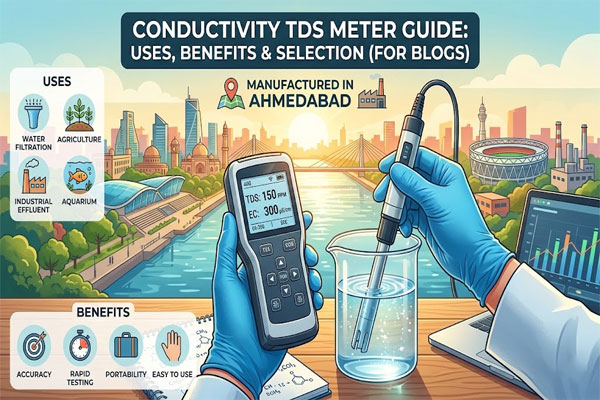
Top Uses & Applications of Conductivity TDS Meters
Water Treatment & Purification
Monitor the effectiveness of reverse osmosis (RO) systems and ion exchange resins.
Pharmaceutical Manufacturing
Ensure water for injection (WFI) meets USP standards for purity.
Food & Beverage Production
Control water quality for beverages, brewing, and food processing.
Boiler Water Management
Maintain optimal water chemistry to prevent scaling and corrosion.
Aquaculture & Fish Farming
Monitor water quality for optimal fish health and growth.
Environmental Monitoring
Assess water quality in lakes, rivers, and wastewater treatment facilities.
Why Choose a Local Conductivity TDS Meter Manufacturer in Ahmedabad
- Direct manufacturer pricing—save 20-30% vs. imported meters
- Same-day technical support and troubleshooting
- On-site installation, calibration, and training
- Fast delivery from stock (no import delays)
- Customized models for local industrial needs
- Comprehensive warranty and preventive maintenance programs
Benefits of Conductivity TDS Meters
How to Select the Right Conductivity TDS Meter
Determine Your Application
Industrial process control, laboratory testing, or field monitoring? This guides feature selection.
Choose Handheld vs. Benchtop
Handheld: Portable, on-site testing. Benchtop: Laboratory-grade accuracy, higher precision.
Check Accuracy & Resolution
For critical applications, invest in meters with ±2% accuracy or better.
Verify Calibration & Support
Ensure the manufacturer offers factory calibration and regular calibration services.
Consider Data Logging Needs
If compliance records are required, choose models with USB, SD card, or cloud connectivity.
Frequently Asked Questions
Conductivity measures the ability to conduct electricity (µS/cm), while TDS measures the total dissolved solids in ppm. They’re related but measure different properties. A combined meter provides both.
Most handheld meters offer ±2-5% accuracy. Laboratory-grade benchtop models can achieve ±1% accuracy.
Yes, but check the meter’s range. Saltwater has much higher TDS (30,000+ ppm) than freshwater (0-2,000 ppm). Ensure your meter can measure up to your expected TDS range.
Monthly for frequent use, quarterly for regular use. Critical applications may require weekly calibration.
Yes! We provide short-term rental options for project-based monitoring or trial periods.
Conclusion
A reliable conductivity TDS meter is an investment in product quality, equipment longevity, and regulatory compliance. By partnering with a trusted manufacturer in Ahmedabad, you ensure access to accurate, calibrated instruments and expert support when you need it most.