
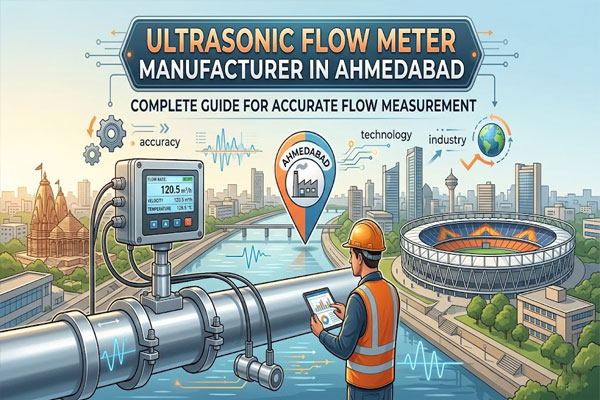
Ultrasonic Flow Meter Manufacturer in Ahmedabad
Accurate flow measurement is critical for operational efficiency, cost control, and regulatory compliance across industries. Ultrasonic flow meters have revolutionized flow measurement with non-invasive technology that works without requiring installation of orifice plates or flow straighteners. If you’re searching for a reliable ultrasonic flow meter manufacturer and supplier in Ahmedabad, this comprehensive guide will help you understand the technology and select the right instrument for your needs.
The Challenge: Traditional Flow Measurement Problems
- Orifice plates and turbine meters cause permanent pressure losses, increasing energy costs
- Installation of flow elements requires expensive piping modifications
- Moving parts in mechanical meters require frequent maintenance and replacement
- Accuracy decreases when measuring viscous liquids or slurries
- Non-contact measurement becomes impossible with traditional technologies
The solution? Ultrasonic flow meters offer non-invasive, no-moving-parts measurement technology. Partner with an experienced manufacturer in Ahmedabad for installation and ongoing support.
What is an Ultrasonic Flow Meter? Complete Definition
An ultrasonic flow meter is a non-invasive instrument that measures the velocity of fluid flow using ultrasonic sound waves. It operates on the Doppler shift principle, detecting the frequency change when ultrasonic waves bounce off particles or bubbles moving with the fluid. The device calculates flow rate from the shift in frequency.
How Ultrasonic Flow Meters Work: The Doppler Principle
Step 1: Signal Transmission
A transmitter sends ultrasonic waves at a specific frequency through the pipe wall into the flowing liquid.
Step 2: Frequency Shift Detection
As waves strike particles/bubbles moving with the fluid, the reflected frequency changes (Doppler effect).
Step 3: Calculation
The receiver detects the frequency shift and calculates the fluid velocity.
Step 4: Flow Rate Determination
The meter multiplies velocity by pipe cross-sectional area to determine total flow rate (m³/h or gallons/minute).
Benefits for Your Industrial Operations
Types of Ultrasonic Flow Meters
| Type | Working Principle | Best For |
| Doppler | Measures frequency shift of waves bouncing off particles | Slurries, dirty water, fluids with suspended solids |
| Transit-Time | Measures time for ultrasonic pulses to travel between transducers | Clean liquids, high accuracy applications, gases |
| Clamp-On | Transducers mounted externally on pipe surface | Quick installation, retrofit applications, no piping changes |
| Inline | Transducers built into pipe connections | Permanent installations, critical applications, full pipeline integration |
Key Features & Advantages
Non-Invasive Installation
Clamps directly to the outside of existing pipes. No cutting, welding, or process interruption required.
No Moving Parts
Minimal maintenance. No wear, tear, or frequent replacements like mechanical meters.
No Pressure Loss
Unlike orifice plates, ultrasonic meters don’t restrict flow or increase energy consumption.
Wide Range of Fluids
Measures clean water, slurries, oils, chemicals, and even molten metals in specialized models.
Real-Time Monitoring
Instant flow rate display and digital data logging for process control.
IoT & Smart Connectivity
Modern units offer Modbus, Hart, Wireless, or Cloud integration for Industry 4.0 systems.
Why Choose an Ultrasonic Flow Meter Manufacturer in Ahmedabad
- Direct manufacturer pricing—20-30% savings vs. imported meters
- Same-day technical support and on-site installation assistance
- Fast delivery from stock or custom configuration in 1-2 weeks
- Expert training for your operations team
- Customized solutions for local industrial applications
- Comprehensive warranty and maintenance programs
Applications of Ultrasonic Flow Meters
Water Utility & Treatment Plants
Measure supply, distribution, and wastewater flow for billing and process optimization.
HVAC Systems
Monitor chilled water and hot water flow for energy efficiency in buildings.
Chemical & Pharmaceutical Manufacturing
Measure precise flow rates of caustic chemicals, acids, and viscous medicines.
Food & Beverage Processing
Non-contact measurement of milk, juice, oils, and other food products.
Thermal Energy Metering
Calculate energy consumption in district heating systems.
Industrial Cooling Systems
Monitor coolant circulation in manufacturing and machinery cooling.
Frequently Asked Questions
They work best on steel, copper, and plastic pipes. Not suitable for extremely thick-walled pipes or clad materials that absorb ultrasonic signals.
Typical accuracy is ±2-3% of measured value. High-end models can achieve ±1% with proper installation.
Air bubbles can affect accuracy. Transit-time meters are less sensitive to bubbles than Doppler meters.
Yes! Modern ultrasonic meters offer Modbus, Hart, Wireless, and Cloud connectivity for Industry 4.0 integration.
15-20 years with minimal maintenance, making them highly cost-effective over their lifetime.
Conclusion
Ultrasonic flow meters represent the future of flow measurement technology. They offer superior reliability, minimal maintenance, and seamless integration with modern control systems. Whether you’re optimizing energy efficiency, ensuring product quality, or achieving regulatory compliance, a properly selected and installed ultrasonic flow meter delivers exceptional value.