
Why Choosing the Right Flow Meter Matters
Picking the right flow meter is one of the most important decisions in any industrial plant. The flow meter touches everything — billing, batch control, chemical dosing, energy balance, and safety. Pick the wrong one, and you get wrong readings, high maintenance, and costly downtime. Pick the right one, and the meter works quietly for years.
There is no single “best” flow meter. The right choice depends on what you are measuring: water, gas, steam, or chemicals. Each fluid behaves differently, and each flow meter type has its strengths. A meter that is perfect for water may fail on steam. A meter that is great for clean gas may not survive dirty chemicals.
This guide will help you select the right flow meter for your application in simple steps. We will cover the main types of flow meters, what they are best for, the key selection criteria, and a quick comparison table. By the end, you will know exactly which meter to choose for water, gas, steam, and chemicals.
Main Types of Flow Meters
Before we look at selection, let us review the most common flow meter types used in industry today.
- Electromagnetic (Mag) Flow Meter: Uses Faraday’s law. Best for conductive liquids like water, slurry, and chemicals. No moving parts.
- Vortex Flow Meter: Measures frequency of vortices behind a bluff body. Best for steam, gas, and clean liquids.
- Coriolis Flow Meter: Measures mass flow directly. Best for high accuracy on liquids, slurries, and even gases.
- Ultrasonic Flow Meter: Uses sound waves. Best for clean liquids and gases. Can be clamp-on (no pipe cut).
- Thermal Mass Flow Meter: Measures gas mass flow using heat transfer. Best for clean gases like air, nitrogen, and CO₂.
- Differential Pressure (DP) Flow Meter: Uses orifice plate, venturi, or pitot tube. Traditional and inexpensive. Best for clean, steady flows.
- Turbine Flow Meter: A rotor turns as fluid flows. Best for clean liquids and gases with steady flow.
- Variable Area (Rotameter): A float in a tapered tube. Best for local indication of small flows.
Step 1: Identify the Fluid
The first and most important step is to know exactly what you are measuring. Ask these questions:
- Is it a liquid, gas, or steam?
- Is the liquid conductive or non-conductive?
- Is the gas clean or dirty?
- Is the steam saturated or superheated?
- Are there solids, bubbles, or abrasives in the fluid?
Each fluid type points to a different flow meter. For example, a magnetic meter only works on conductive liquids. A vortex meter works on steam but not on low-pressure gas at very low velocity.
Step 2: Know the Pipe Size and Flow Range
Next, find out:
- Pipe size (in inches or mm)
- Minimum, normal, and maximum flow rate
- Operating pressure and temperature
Every flow meter has a turndown ratio (the ratio of max to min flow it can measure accurately). Most modern meters have a turndown of 10:1 to 100:1. Make sure your normal flow falls inside the meter’s accurate range.
Step 3: Decide the Accuracy You Need
Different applications need different accuracy.
- Custody transfer / billing: ±0.5% or better — use Coriolis or ultrasonic.
- Process control: ±1% is usually enough — use vortex, mag, or DP.
- Simple indication: ±2% to ±5% — rotameter or basic DP works.
Step 4: Think About Installation
Some flow meters need a lot of straight pipe before and after the meter. Others can work in tight spaces.
- Mag meters: Need 3 to 5 diameters of straight pipe upstream.
- Vortex meters: Need 10 to 20 diameters upstream.
- Ultrasonic (clamp-on): Need a clean pipe wall and enough straight length.
- Coriolis: Almost no straight pipe needed, but the meter itself is heavy.
Step 5: Look at Cost and Maintenance
The cheapest meter is not always the best. Think about the lifetime cost:
- Initial cost of the meter
- Installation cost (cutting pipe, downtime, fittings)
- Calibration cost (every 1 to 3 years)
- Spare parts and service
- Power consumption (some meters use a lot)
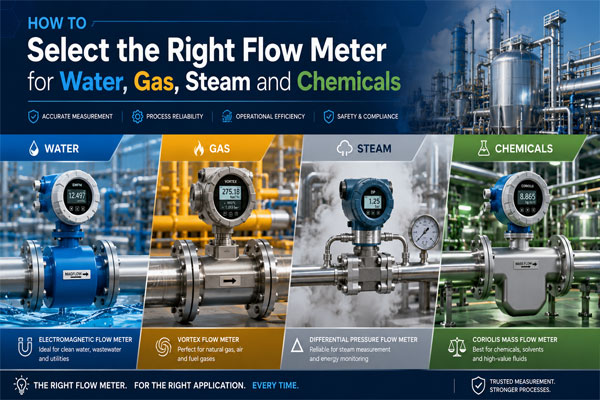
Best Flow Meter for Water
For water flow measurement, the most common choices are:
- Electromagnetic (Mag) Flow Meter: Best overall for clean or dirty water. No pressure drop. Very accurate (±0.5%). Works for raw water, treated water, and even sewage.
- Ultrasonic Flow Meter: Best when you cannot cut the pipe (clamp-on). Works for clean water with low air bubbles.
- Turbine Flow Meter: Best for clean water with steady, high flow. Good for irrigation and bulk metering.
Best Flow Meter for Gas
For gas flow measurement, the right choice depends on the gas type.
- Thermal Mass Flow Meter: Best for clean gases like air, nitrogen, oxygen, and CO₂. Direct mass flow reading.
- Vortex Flow Meter: Good for general gas measurement, including natural gas, when the flow is above the minimum velocity.
- Ultrasonic Flow Meter: Best for large pipelines, custody transfer, and dirty gases. No pressure drop.
- DP (Orifice) Flow Meter: Common in oil and gas for custody transfer. Lower accuracy and high pressure loss.
Best Flow Meter for Steam
For steam flow measurement, there are two clear winners.
- Vortex Flow Meter: The most common choice for steam. Works for both saturated and superheated steam. No moving parts. Good accuracy (±1%).
- DP Flow Meter with Condensation Pot: Traditional choice for steam. Lower cost but more maintenance.
For high-accuracy steam measurement, you can also use a Coriolis meter, but it is more expensive.
Best Flow Meter for Chemicals
For chemical flow measurement, the choice depends on whether the chemical is conductive or not.
- Conductive chemicals (acids, bases, salt water): Use an electromagnetic flow meter with a PTFE, PFA, or rubber liner. Stainless steel or Hastelloy electrodes handle corrosive liquids.
- Non-conductive chemicals (oils, solvents, fuels): Use a Coriolis meter for highest accuracy. A vortex or turbine meter also works for clean fluids.
- Slurries and abrasive chemicals: Use an electromagnetic flow meter with an abrasion-resistant liner, or a Coriolis meter.
Flow Meter Comparison Table
Here is a quick comparison of the main flow meter types and where they work best.
| Flow Meter Type | Best For | Accuracy | Pressure Drop | Cost |
|---|---|---|---|---|
| Electromagnetic (Mag) | Water, slurry and conductive chemicals | ±0.5% | None | Medium |
| Vortex | Steam, gas and clean liquids | ±1% | Medium | Medium |
| Coriolis | Mass flow and high-accuracy liquids and gases | ±0.1% | Medium | High |
| Ultrasonic (Inline) | Clean liquids and custody transfer | ±0.5% | None | High |
| Ultrasonic (Clamp-On) | Retrofits, clean water and installations without pipe cutting | ±1% to ±2% | None | Medium |
| Thermal Mass | Clean gases such as air, N₂ and CO₂ | ±1% to ±2% | Low | Medium |
| Differential Pressure (DP) | Steam, gas and water applications | ±1% to ±3% | High | Low |
| Turbine | Clean liquids and gases | ±0.5% | Medium | Low |
| Variable Area (Rotameter) | Local indication and small flow rates | ±2% to ±5% | Low | Low |
Key Takeaway: For most water applications, use a mag meter. For steam, use a vortex meter. For gases, use a thermal mass or ultrasonic meter. For chemicals, use a mag or Coriolis meter based on conductivity.
Common Selection Mistakes to Avoid
- Picking by price alone: A cheap DP meter on steam may cost more in pressure loss and maintenance than a vortex meter.
- Ignoring fluid conductivity: A mag meter on oil or pure chemical will not work. Check the conductivity first.
- Forgetting straight pipe length: A vortex meter in a tight pipe run gives bad readings. Always allow straight pipe before and after.
- Not checking temperature and pressure limits: Standard mag meters work up to 130°C. High-temperature steam needs a special design.
- Skipping calibration budget: Every flow meter needs calibration. Plan for it from day one.
Problems Solved by Picking the Right Flow Meter
Many plants have the same issues. Here is how the right flow meter fixes them.
- Problem: Flow readings drift and billing is wrong.
Solution: Pick a higher-accuracy meter like Coriolis or mag. Calibrate it yearly. - Problem: Steam meter fails every few months.
Solution: Use a vortex meter designed for the right pressure and temperature range. Add a condensate pot if needed. - Problem: Chemical meter is corroded after a few weeks.
Solution: Pick a mag meter with the right liner (PTFE, PFA) and electrodes (Hastelloy, titanium) for the chemical. - Problem: Gas meter reads zero at low flow.
Solution: Use a thermal mass meter with a low-flow cutoff, or a Coriolis meter. - Problem: Cannot shut down the line to install a meter.
Solution: Use a clamp-on ultrasonic meter. No pipe cutting needed.
How Aranka Instruments Can Help
At Aranka Instruments, we help engineers and plant teams pick the right flow meter for their fluid and application. We supply mag meters, vortex meters, Coriolis meters, ultrasonic meters, and thermal mass flow meters from trusted brands. We also provide installation, calibration, and after-sales service across India.
Conclusion
Choosing the right flow meter for water, gas, steam, and chemicals is a step-by-step process. Start with the fluid, then check flow range, accuracy, installation, and cost. There is no single best flow meter — only the best meter for your specific application. When in doubt, ask an instrument expert. A small effort in selection saves years of headaches on the plant floor.
Frequently Asked Questions (FAQs)
To select the right flow meter, identify the fluid type, pipe size, flow range, temperature, pressure, accuracy needed, and budget. Then match these to a flow meter type such as electromagnetic, vortex, Coriolis, ultrasonic, or differential pressure.
For clean water, an electromagnetic flow meter is the most popular choice. It is accurate, has no moving parts, and works for a wide range of flows. For dirty water, a Doppler ultrasonic meter is also a good option.
A vortex flow meter is the most common choice for steam. It works for both saturated and superheated steam and gives good accuracy without moving parts.
For clean gases, a thermal mass flow meter or vortex meter works well. For large pipelines and custody transfer, an ultrasonic flow meter is often used.
For conductive chemicals, an electromagnetic flow meter with a PTFE or rubber liner is ideal. For non-conductive chemicals, use a Coriolis, vortex, or ultrasonic meter based on viscosity and accuracy needs.
No single flow meter works well on all four fluids. Each fluid type needs a specific flow meter design. The right meter depends on conductivity, viscosity, temperature, and pressure.
Coriolis flow meters are the most accurate, with ±0.1% accuracy for mass flow. They work on liquids, slurries, and even gases, but they cost more than other types.