

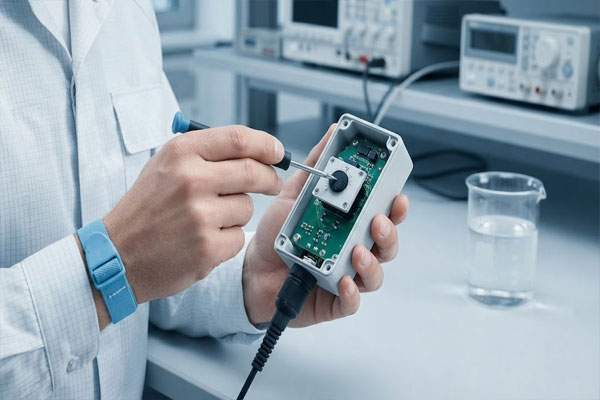
Choosing the right level instrument is critical for maintaining safe and efficient industrial processes. Incorrect level-switch selection can lead to serious operational failures, such as dangerous tank overflows, unexpected pump dry running, costly equipment damage, and severe process interruptions. When dealing with water or water-based chemicals, a conductivity level switch is often the most reliable and cost-effective solution available.
However, selecting the perfect instrument requires a clear understanding of your process conditions. You must evaluate the liquid’s properties, tank dimensions, and control logic requirements to ensure seamless automation. This guide explores everything you need to know about conductive liquid detection, from its core working principle to practical selection factors, helping you choose the best instrument for your specific industrial application.
What Is a Conductivity Level Switch?
A conductivity level switch is an electronic device designed to detect the presence or absence of conductive liquids at specific points within a tank or vessel. It uses metal probes to sense the liquid level and trigger appropriate control actions.
- High-level detection: Preventing tanks from overflowing.
- Low-level detection: Alerting operators before a tank runs completely dry.
- Overflow protection: Automatically shutting off supply lines when limits are reached.
- Dry-run protection: Stopping pumps when liquid levels drop too low.
- Pump control: Automatically starting and stopping pumps for filling or emptying.
- Valve control: Opening or closing automated valves based on liquid levels.
- Alarm activation: Triggering sirens or flashing lights in a control room.
What Makes a Liquid Conductive?
For an electrode level switch to function, the target liquid must possess adequate electrical conductivity. This conductivity relies entirely on the presence of dissolved ions, salts, and minerals within the fluid. Pure, demineralized water is a poor conductor, but adding even a small amount of minerals drastically changes its electrical properties.
Suitable conductive liquids include:
- Water (tap, borewell, and cooling water)
- Wastewater and sewage
- Many aqueous chemical solutions
- Acids and alkalis
- Various process liquids with sufficient conductivity
Oils, fuels, many industrial solvents, and very low-conductivity liquids will not work with this technology. In those cases, another measurement method may be required.
Maximum and Minimum Level Control
A conductive level switch is highly versatile and can be configured for multiple control strategies.
Maximum level control: Acts as a maximum level switch to provide a high-level alarm or overflow prevention. This safely shuts down filling pumps when a tank is full.
Minimum level control: Functions as a minimum level switch to trigger a low-level alarm or provide pump dry run protection, stopping a pump before it runs empty and overheats.
Two-point pump control: Multiple probes allow automated filling control or emptying control by using separate low and high switching points.
Conductivity Level Switch Working Principle
The conductivity level switch working principle is highly dependable because it contains no moving parts.
01. Install Electrodes: Electrodes are installed at the exact selected levels inside the tank.
02. Liquid Reaches Probe: The conductive liquid rises and eventually touches the metallic electrodes.
03. Circuit Completes: The liquid completes a low-voltage electrical path between the active electrode and a reference electrode.
04. Resistance Changes: The controller detects the sudden change in electrical resistance.
05. Relay Activates: A relay output activates inside the controller.
06. Control Action: A pump, valve, alarm, or PLC receives the signal to execute the programmed action.
Main Components of a Conductivity Level Switch
Controller: The electronic brain that generates the low-voltage signal and processes resistance changes.
Probe: The physical assembly that houses the measuring rods.
Electrode Rod: Conductive metal rods that make direct contact with the liquid.
Reference Electrode: Required electrical ground path, which can be the metallic tank wall or a dedicated longest rod.
Insulator: Non-conductive material covering parts of the rods to prevent false switching from splashing.
Relay Output: Electrical switch that controls external devices like pumps or alarms.
Sensitivity Adjustment: A dial or setting used to match the controller to the liquid’s conductivity level.
Time Delay: Delays relay action to ignore temporary splashing or liquid turbulence.
DIN Rail / Panel Mounting: Mounting style for the external controller unit.
Enclosure: Protective housing for the probe head and electronics, often rated for harsh environments.
Types of Conductivity Level Switches
Manufacturers offer various designs to suit different industrial needs:
Important Selection Factors
Selecting the perfect conductivity probe requires careful evaluation of your specific application.
Liquid Conductivity: Adequate electrical conductivity is essential. There is no universal minimum value for every device, so exact suitability depends on the liquid and selected product specifications.
Chemical Compatibility: Verify electrode, probe body and insulation materials such as stainless steel, titanium, PTFE or PVC against the process liquid.
Temperature and Pressure: Process ratings must strictly match the application. High temperature can melt plastic probe bodies, while excessive pressure can breach mechanical seals.
Tank Material: Metallic tanks can often serve as the reference electrode. Plastic, fiberglass or rubber-lined tanks require an additional longer reference rod.
Number of Switching Points: Single-point works for a simple alarm. Pump automation requires at least two control points plus a reference rod.
Probe Length: Measure tank depth and exact switching levels so the rods reach the required control points.
Mounting Position: Options include top, side, threaded, flanged and hygienic mounting where applicable. Top mounting is common for multi-point water level switches.
Foam, Coating and Deposits: Conductive film between rods can cause false switching, while heavy buildup can insulate rods and cause failure.
Relay Output and Control Logic: Confirm pump, valve, alarm, PLC and panel requirements, including normally open (NO) or normally closed (NC) logic.
Sensitivity and Time Delay: Adjustable sensitivity can help ignore conductive foam, while time delay can ignore turbulent waves during filling.
Power Supply: Match the available panel supply, such as 24V DC, 110V AC or 230V AC. Applying the wrong voltage can destroy the controller.
Enclosure Protection: Review indoor, outdoor, dusty, wet and hazardous conditions and choose an appropriate IP rating such as IP65 or IP67.
Conductivity Level Switch Selection Checklist
Use this practical checklist before purchasing your liquid level controller:
☐ Liquid accurately identified
☐ Liquid conductivity confirmed as sufficient
☐ Chemical compatibility of wetted parts checked
☐ Maximum process temperature recorded
☐ Maximum process pressure recorded
☐ Tank material (metal vs. plastic) confirmed
☐ Tank depth accurately measured
☐ Number of switching points decided
☐ Required probe length selected
☐ Process mounting type selected
☐ Relay output requirement confirmed
☐ Required power supply confirmed
☐ Presence of foam and deposits considered
☐ Environmental enclosure protection reviewed
☐ Safe maintenance and cleaning access checked
Common Selection Mistakes
Avoid these frequent errors that lead to system failures:
- Selecting the technology for a completely non-conductive liquid.
- Ignoring probe material compatibility with aggressive acids.
- Ordering the wrong probe length for the tank’s operational depth.
- Choosing the wrong switching logic for the filling or emptying task.
- Poor probe location near turbulent inlet pipes.
- Ignoring the presence of conductive foam.
- Ignoring heavy, sticky deposits that insulate the rods.
- Providing an incorrect power supply voltage to the controller.
- Incorrect output selection for PLC integration.
- Forgetting a reference rod in a non-conductive tank.
- Ignoring maximum process temperature and pressure limits.
Applications of Conductivity Level Switches
Because of their reliability and low cost, these switches are widely used across multiple industries:
- Water tanks in commercial and residential buildings
- Industrial sumps and drainage pits
- ETP and STP plants
- RO plants for raw water monitoring
- Cooling towers for level maintenance
- Boiler feed-water tanks
- Automated pump-control systems
- Chemical tanks containing aqueous solutions
- General industrial automation projects
- Food-processing applications where materials are compatible
- Tank overflow protection alarms
- Reliable pump dry run protection
Conductivity Level Switch vs Float Level Switch
| Feature | Conductivity Level Switch | Float Level Switch |
|---|---|---|
| Working Principle | Electrical conductivity of the liquid | Liquid buoyancy lifting a physical float |
| Moving Parts | None | Yes (the float mechanism) |
| Liquid Requirement | Must be electrically conductive | Works with both conductive and non-conductive liquids |
| Installation | Mostly top-mounted | Top or side-mounted options available |
| Maintenance | Periodic cleaning of electrodes | Routine checking for mechanical jams or stuck floats |
| Switching Points | Multiple points easily handled in one probe | Usually limited to one or two points per assembly |
| Suitable Applications | Water, wastewater, conductive chemicals | Oils, fuels, clean water, non-coating liquids |
If you are dealing with clean, non-coating liquids or oils, a float level switch might be a suitable alternative.
Conductivity Level Switch vs Capacitive Level Switch
| Feature | Conductivity Level Switch | Capacitive Level Switch |
|---|---|---|
| Working Principle | Detects a completed electrical circuit | Detects a change in electrical capacitance |
| Liquid Suitability | Conductive liquids only | Both conductive and non-conductive liquids |
| Deposit Handling | Sensitive to heavy, sticky buildup | Advanced models can ignore heavy material buildup |
| Cost | Generally very economical | Moderate to higher investment |
When Should Another Level Technology Be Used?
Conductivity is highly effective, but it is not a universal solution. Select another level technology when dealing with:
- Non-conductive liquids like pure demineralized water.
- Oils, fuels and petrochemicals.
- Heavy coating liquids that leave thick, insulating sludge.
- Continuous level measurement requirements.
- Strict hygienic applications requiring completely flush sensors.
- Highly pressurised vessels that exceed standard probe ratings.
- Difficult foam conditions that bridge electrodes constantly.
Alternative technologies include float, capacitive, optical, ultrasonic, radar and hydrostatic level instruments.
Installation and Maintenance Tips
- Maintain correct probe spacing to prevent water droplets from bridging the gap.
- Ensure secure wiring between the probe head and conductivity controller.
- Establish a proper reference connection to the metal tank or longest reference rod.
- Perform periodic electrode cleaning to remove rust, scale or biological buildup.
- Conduct functional testing during planned shutdowns by manually shorting the rods.
- Avoid contact between probe rods by using PTFE spacers on very long assemblies.
- Regularly check for insulating deposits on rod tips.
- Inspect relay operation to ensure contacts are not worn or fused.
Conductivity Level Switches from Aranka Instruments
Aranka Instruments LLP is a trusted conductivity level switch manufacturer supplying robust and precise level instruments to heavy industry. Operating as a leading conductivity level switch manufacturer in India, we help engineers tackle difficult liquid automation challenges.
Based in Ahmedabad, Gujarat, India, our team designs solutions tailored for water treatment, chemical processing, and industrial automation. Whether you need a standard level switch for a water tank or a highly customized, multi-point conductivity sensor for a complex ETP plant, we provide reliable instruments built to strict verified specifications.
Conclusion
Selecting a conductivity level switch doesn’t have to be complicated, but it does demand attention to detail. By confirming your liquid’s conductivity, matching chemical compatibilities, and correctly defining your control points, you can establish an automated system that protects your pumps and prevents hazardous overflows.
Ready to upgrade your liquid level control system? Please reach out through our contact page and provide our team with the following details for a precise product recommendation:
- Liquid name
- Expected conductivity
- Tank material
- Tank depth
- Switching points required
- Temperature and Pressure
- Probe material preference
- Process connection size
- Controller location (integral or panel)
- Power supply available
- Output requirement
Technically reviewed by the Aranka Instruments engineering team.
Frequently Asked Questions
It is an electronic level-sensing device that uses metal electrode rods to detect the presence of electrically conductive liquids at specific points within a tank or vessel, triggering control relays for pumps or alarms.
It works by using the process liquid to complete a low-voltage electrical circuit. When the liquid touches the electrodes, it closes the electrical path. A controller senses this change in resistance and activates a relay output.
It can successfully detect any liquid with sufficient electrical conductivity. Common examples include tap water, groundwater, wastewater, sewage, cooling water, and various aqueous solutions containing acids or alkalis.
No, it cannot detect oil. Oils, fuels, and petrochemicals are electrical insulators. Because they lack dissolved ions, they cannot complete the electrical circuit required for the switch to function.
Yes, it can be used in a plastic tank, but you must install a reference electrode rod. Because plastic is non-conductive, the tank wall cannot act as the electrical ground, so a dedicated, longer reference rod is required.
A reference electrode acts as the essential electrical ground path for the low-voltage circuit. The system measures the resistance between the shorter, active measurement rods and this continuous reference point.
Yes, it is widely used to control water pumps. By using multiple electrode rods set at different lengths, the switch can easily automate filling and emptying cycles for reservoirs and sumps.
Maximum control acts as a high-level alarm or overflow protection to stop filling. Minimum control acts as a low-level alarm or provides dry-run protection to stop a pump before it runs dry.
Yes. Conductive foam can bridge the gap between electrodes, causing a false high-level alarm. Heavy, sticky deposits can coat the electrodes, insulating them from the liquid and causing the switch to fail to detect the true level.
You must select a probe material based entirely on the chemical compatibility of your target liquid. Stainless steel (SS316) is standard for water, while aggressive chemicals may require titanium or Hastelloy electrodes with PTFE insulation.